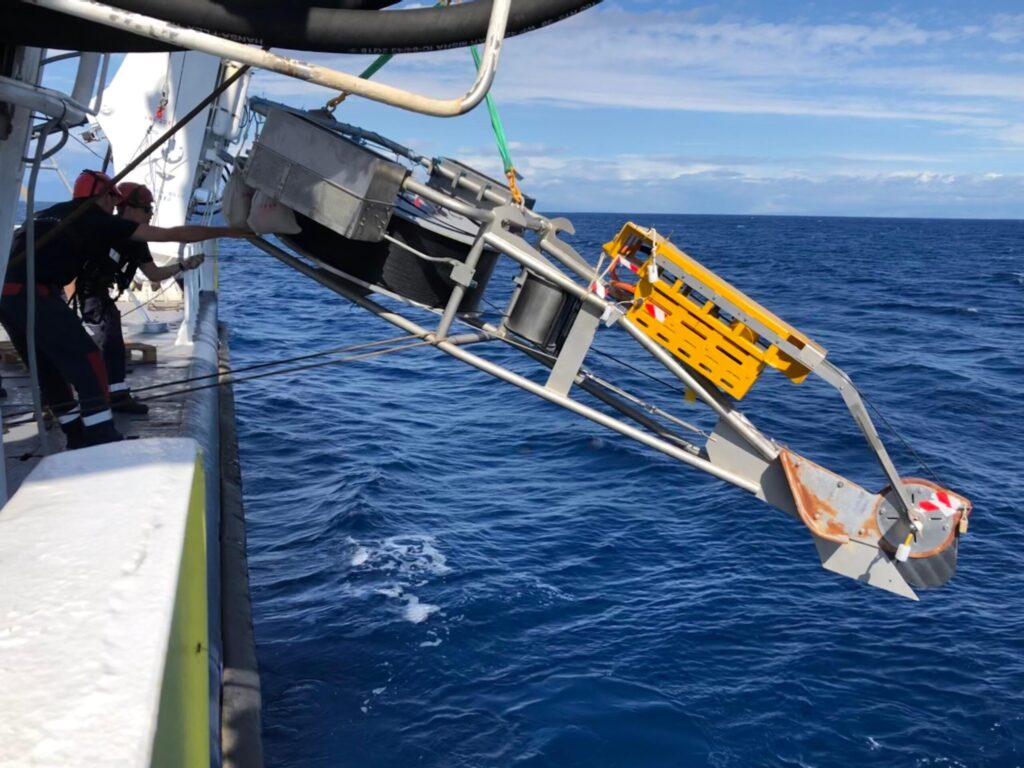
At a café in London Heathrow recently, one of us submitted an assignment, asked ChatGPT about Florida’s best barbecue, tapped a card for coffee, and did all of it within minutes, without once thinking about where any of it happened. So much of digital life feels wireless, weightless, almost placeless. We call the realm of digital space “the cloud,” a term that belies how much of modern life runs through dark, cold spaces far below the ocean’s surface. In reality, much of the world’s international data travels through submarine cables that carry traffic across borders and oceans. The more indispensable these hidden arteries are, the more they become strategic terrain rather than simple infrastructure.
The Importance of Submarine Cables
Submarine cables remain the physical backbone of the global digital economy, carrying over 95 percent of intercontinental Internet traffic. They enable everything from financial transactions and video calls to government communications and online shopping. Their importance to global Internet traffic makes them both strategically valuable and uniquely vulnerable. Damage to the wires can result from anchors, fishing activity, geological events, aging infrastructure or deliberate interference. Repairs may take weeks to months. For governments, the problem is not only connectivity. A major cable disruption can threaten economic stability, crisis communication, and public confidence in state capacity. Cable security is therefore increasingly understood not simply as repair after failure, but as a broader resilience challenge involving prevention, detection, response, recovery, and deterrence. [1]
This vulnerability is not hypothetical. In 2023, when two submarine communications cables were damaged, the island of Matsu off the coast of Taiwan experienced an Internet outage that affected 13,000 people, forcing residents to depend on limited microwave backup and turning the incident into a test of communications resilience in Taiwan. [2] The risk is not limited to cuts. During the Cold War, Operation Ivy Bells demonstrated that undersea cables could also be targeted for covert access and surveillance. [3]
This collision of indispensability, vulnerability, and strategic sensitivity turns submarine cables from a technical concern into a test of strategic discipline. For the United States and China, these cables mark a domain where neither side can afford the chaos of unmanaged escalation. Because both powers share this physical vulnerability, the analytical challenge shifts away from a search for trust toward the design of guardrails. The relevance of submarine cables, therefore, lies not just in the data they carry, but in their potential to support a guarded form of coordination, one designed to manage a high-stakes rivalry without requiring either side to surrender its core suspicions.
The May 2026 Xi–Trump summit gives this logic a sharper diplomatic setting. Its official language of a “constructive relationship of strategic stability” keeps trust largely at the level of diplomatic formality, while the substantive task remains narrower: keeping competition bounded, disagreements manageable, and escalation more predictable through open channels of communication. [4][5]
The International Background: Securitization of Submarine Cables
Over the past decade, submarine cables have become increasingly securitized. Today, governments view such cables not only as commercial and technical infrastructure, but also as matters of strategic competition. This shift does not mean that cables have ceased to function as infrastructure. Rather, it means that governments now exercise tighter oversight over project stakeholders, landing sites, maintenance protocols, and the latent political risks of foreign involvement.
This transition appears in three trends. First, governments have expanded security review and licensing procedures. The clearest example is the 2020 U.S. recommendation to deny the Hong Kong branch of the Pacific Light Cable Network, given concerns over PRC-linked ownership and potential Chinese government access to data. Meanwhile, it allowed the Taiwan and Philippines segments to proceed with added national-security safeguards. [6] Second, multilateral attention has shifted toward infrastructure survivability, as will be discussed later. [7] Third, security concerns about Chinese vendors have increasingly shaped who is trusted to build cable infrastructure. This pattern has become more visible since 2018, when Australia stepped in to fund an undersea cable for the Solomon Islands and Papua New Guinea to keep China’s Huawei out of the project on the grounds of perceived security hazard. [8]
The defining change is not the disappearance of international coordination, but its realignment. Coordination is now shaped less by cost and efficiency alone and more by trust, vulnerability, and strategic risk. In short, cables still bind economies together, but states increasingly weigh the connectivity they offer against the dependency and vulnerability they create.
U.S.–China Confrontation in Submarine Cable Infrastructure
In the era of digital connectivity, U.S.-China competition has now extended to physical infrastructure. It shapes not only who can lay submarine cables, but also where they are laid and what obligations they impose. [9] Compared to software platforms or data rules, cable issues are tied to physical cable locations, landing points, and territorial authorities. Construction, approval, and repair decisions can therefore be easily affected by political mistrust. Submarine cables are also not purely commercial operations on Beijing’s end. To some extent, China interprets U.S. pressure as strategic rather than purely market competition because cable construction fits into its larger plans for maritime and digital connectivity, as outlined by the National Development and Reform Commission and the State Oceanic Administration. [10]
A primary friction point is the selection of submarine cable providers. Western companies, like SubCom, and Chinese companies, like HMN Tech, are no longer bidding on price or technical capability alone. [11] The Southeast Asia-Middle East-Western Europe 6 cable is an example of this. The contract was ultimately awarded to SubCom even though HMN Tech had submitted a lower bid, suggesting that the decision was shaped by U.S. diplomatic pressure and fears that a Chinese supplier might give Beijing access to sensitive information or influence over the cable. [12]
Even routing and landing points have now come under question. The Pacific Light Cable Network case illustrates how a security review may determine the landing point for a cable. The rejection of the Hong Kong landing location was based on national security grounds, with the later approval of the Taiwan and Philippines connections under mitigation conditions. [6][13] In this environment, licensing is no longer a technical formality. It has become one of the primary instruments by which governments manage security risk.
At the same time, the cable system has not been bifurcated into two blocs. Some countries and operators have maintained ties to Chinese suppliers where U.S. leverage is lower or where the security issue is less direct. For instance, despite pressure from Australia, Japan, and the United States to abandon its existing Huawei contract on security grounds, Papua New Guinea has continued to cooperate with China. [14] The outcome is therefore not a clean break, but a gradual sorting of networks around trusted partners. The sharper concern lies in disputed maritime areas, such as the Taiwan Strait and the South China Sea. In these regions, even when a cable is not disrupted intentionally, disruption can still generate suspicion and political pressure. [15]
Viewed collectively, these cases confirm that submarine cables are no longer peripheral to grand strategy. They are embedded in a competition where construction and operation are increasingly shaped by geopolitical logic rather than commercial calculation. This is why cables matter for U.S.–China guardrails.
Guardrails Under Rivalry
At this point, vulnerability forces strategic rivals to confront a shared problem of restraint. They do not fit the ordinary language of cooperation. This is not somewhere Washington and Beijing can realistically restore trust, pool strategic assets, or move toward any deep institutional partnership. The problem is narrower and harder. Both sides depend on a stable cable system. Both also understand that openness in this domain, whether through infrastructure access, operational transparency, technical integration, or supply-chain exposure, remains a potential source of strategic leverage. The difficult part is that dependence does not soften mistrust. The more both sides rely on the same system, the more each side worries about how the other might use that system in a crisis.
Security-dilemma logic captures part of this dynamic, but not all of it. When states operate under conditions of uncertainty, even measures that appear defensive to one side can look dangerous to the other because intentions remain uncertain and future behavior cannot be guaranteed. In that setting, each side has reason to protect itself even while recognizing that mutual restraint would leave both better off. [16] The bargaining problem adds another layer. A shared interest in avoiding disruption does not automatically produce stable bargains when each side fears concealment, misperception, or a later shift in capabilities and intentions. [17]
Submarine cables sit squarely inside that problem. That is why “more cooperation” is too blunt a phrase. Deep cooperation would require a level of reassurance that current U.S.–China relations cannot sustain. The regulatory trajectory already points in the opposite direction. In the United States, submarine cable licensing has moved more explicitly into the language of foreign adversary risk, with tighter scrutiny of ownership, access, and control replacing any previous presumption of neutral interdependence. [18] This defensive shift creates a structural ceiling for ambitious bilateral trust-building, reflecting a broader shift in which connectivity itself becomes a security problem.
The more realistic model is therefore bounded coordination: limited engagement designed to keep rivalry from becoming more dangerous than either side wants. The best historical analogy is the 1972 U.S.–Soviet Incidents at Sea Agreement. That agreement did not emerge from reconciliation. It emerged from repeated encounters between adversaries who understood that operating without rules created unnecessary risks of collision, misreading, and escalation. Its purpose was modest and hard-headed. It sought to regulate dangerous interactions, create practical understandings, and reduce the chance that routine rivalry would spiral into crisis. [19]
The 1963 establishment of a direct communications link between Washington and Moscow rested on a similar intuition. Adversaries with little trust still found value in a narrow mechanism that could reduce delay, ambiguity, and catastrophic misunderstanding in moments of tension. [20] Strategic hostility therefore limits coordination to modest danger-reduction measures, not deeper trust-building.
Submarine cables pose a similar problem. The relevant question is whether the United States and China can build narrow guardrails around a domain of shared vulnerability. In practice, this means handling deconfliction through technical procedures. The focus shifts to institutionalizing contingency protocols: Who gets notified? Who repairs the cable? Who has access to the site, and does that access require a joint or third-party chaperone? What evidence is shared before either side turns an accident into an accusation?
Technical survival requires no political warmth; it requires procedures that can operate before suspicion hardens into accusation. That need becomes more urgent as technologies capable of physically interfering with submarine cables develop. China has reportedly tested a deep-sea cable-cutting device capable of operating at depths of up to 3,500 meters. Even if such technology has civilian uses, its dual-use character is likely to deepen mistrust and reinforce worst-case assumptions about intent. [21]
Deep mistrust makes procedures more necessary. Recent international efforts already point in this direction. The International Advisory Body for Submarine Cable Resilience (IAB), a joint initiative by the UN’s International Telecommunication Union and the non-profit International Cable Protection Committee, was launched to strengthen resilience through technical interoperability and continuity of communications, rather than through any grand project of political reconciliation. [7] The IAB’s Porto Declaration in 2026 follows the same logic, emphasizing maintenance coordination and the removal of regulatory frictions that slow rapid physical recovery. [22] At the regional level, the European Union has similarly moved toward a doctrine of “strategic resilience,” prioritizing attribution capacity, maritime surveillance, and the rapid mobilization of repair fleets so that the system remains viable even in a high-threat environment. [23] What stands out across these initiatives is their restraint. They do not promise trust. They promise procedures.
This restraint matters because the legal baseline remains thin. International law provides some foundation: the law of the sea recognizes the freedom to lay submarine cables and includes provisions concerning damage and liability. [24] Yet that framework was never designed to manage twenty-first-century gray-zone competition around critical digital infrastructure. It offers a floor, but not a crisis management architecture. What remains missing is a thicker layer of operational practice for a world in which cable cuts may be accidental, reckless, coercive, or simply ambiguous in ways that invite overreaction.
The real test is smaller but harder. Can the United States and China walk this long, narrow line by writing rules for a system they both need, while admitting that neither side trusts the other? This is a more pragmatic ambition—not dissolving friction into partnership but installing guardrails that keep an unavoidable rivalry from sliding into catastrophe. Submarine cables offer a real test of whether the May 2026 summit’s strategic-stability language can leave the communiqué and enter the operational world. The question is whether two states that distrust each other can still agree on narrow procedures for a domain where a single act of sabotage can sever markets, militaries, and publics at once. [25][26]
For all our talk of the “cloud,” modern life still runs through hidden physical worlds we rarely imagine until something goes wrong. Submarine cables belong to that world: unseen, indispensable and now increasingly shadowed by strategic rivalry. They do not simply tell us something about technology. They tell us something about the century taking shape—one in which dependence remains shared, trust remains thin, and danger may arrive less through spectacle than by the quiet failure of things once taken for granted.
References
[1] Joint Research Centre. (2025, August 8). “Subsea Cables: How Vulnerable Are They and Can We Protect Them?” European Commission. https://joint-research-centre.ec.europa.eu/jrc-explains/subsea-cables-how-vulnerable-are-they-and-can-we-protect-them_en.
[2] Lii, W. (2023, April 15). “After Chinese Vessels Cut Matsu Internet Cables, Taiwan Seeks to Improve Its Communications Resilience.” The Diplomat. https://thediplomat.com/2023/04/after-chinese-vessels-cut-matsu-internet-cables-taiwan-shows-its-communications-resilience/.
[3] Carle, M. (2017, February 7). “The Mission Behind Operation Ivy Bells and How It Was Discovered.” Military.com. https://www.military.com/history/operation-ivy-bells.html.
[4] Ministry of Foreign Affairs of the People’s Republic of China. (2026, May 14). “习近平同美国总统特朗普会谈.” https://www.fmprc.gov.cn/web/gjhdq_676201/gj_676203/bmz_679954/1206_680528/xgxw_680534/202605/t20260514_11910264.shtml.
[5] White House. (2026, May 17). “Fact Sheet: President Donald J. Trump Secures Historic Deals with China, Delivering for American Workers, Farmers, and Industry.” https://www.whitehouse.gov/fact-sheets/2026/05/fact-sheet-president-donald-j-trump-secures-historic-deals-with-china-delivering-for-american-workers-farmers-and-industry/.
[6] U.S. Department of Justice. (2020, June 17). “Team Telecom Recommends That the FCC Deny Pacific Light Cable Network System’s Hong Kong Undersea Cable Connection to the United States.” https://www.justice.gov/archives/opa/pr/team-telecom-recommends-fcc-deny-pacific-light-cable-network-system-s-hong-kong-undersea.
[7] International Telecommunication Union. (2024, November 29). “Launch of International Advisory Body to Support Resilience of Submarine Telecom Cables.” https://www.itu.int/en/mediacentre/Pages/PR-2024-11-29-advisory-body-submarine-cable-resilience.aspx.
[8] Reuters. (2018, June 13). “Australia keeps China out of internet cabling for Pacific neighbor.” https://www.reuters.com/article/technology/australia-keeps-china-out-of-internet-cabling-for-pacific-neighbor-idUSKBN1J90JU/.
[9] Abels, J., & Babić, M. (2026, January 20). “Cable Wars? Mapping the Political Economy of Submarine Cables in an Era of Geoeconomic Competition.” Globalizations. https://www.tandfonline.com/doi/full/10.1080/14747731.2025.2599691.
[10] National Development and Reform Commission & State Oceanic Administration. (2017, June 20). “Vision for Maritime Cooperation under the Belt and Road Initiative.” State Council of the People’s Republic of China. https://english.www.gov.cn/archive/publications/2017/06/20/content_281475691873460.htm.
[11] Asia New Zealand Foundation. (2026, February 25). “Wired for Power: The Geopolitics of Subsea Cables in the South China Sea.” https://www.asianz.org.nz/wired-for-power-the-geopolitics-of-subsea-cables-in-the-south-china-sea.
[12] Carnegie Endowment for International Peace. (2024, December 18). “Subsea Communication Cables in Southeast Asia: A Comprehensive Approach Is Needed.” https://carnegieendowment.org/research/2024/12/southeast-asia-undersea-subsea-cables.
[13] U.S. Department of Justice. (2021, December 17). “Team Telecom Recommends FCC Grant Google and Meta Licenses for Undersea Cable.” https://www.justice.gov/archives/opa/pr/team-telecom-recommends-fcc-grant-google-and-meta-licenses-undersea-cable.
[14] TelecomLead. (2018, November 26). “Papua New Guinea to Work with Huawei Despite External Pressure.” https://telecomlead.com/telecom-equipment/papua-new-guinea-to-work-with-huawei-despite-external-pressure-87648.
[15] Istituto Affari Internazionali. (2026, January 2). “What Lies Beneath: Hybrid Threats to Taiwan’s Submarine Cables and the Contest in the Information Domain.” IAI Papers, 26/01. https://www.iai.it/sites/default/files/iaip2601.pdf.
[16] Jervis, R. (1978). “Cooperation Under the Security Dilemma.” World Politics, 30(2), 167–214.
[17] Fearon, J. D. (1995). “Rationalist Explanations for War.” International Organization, 49(3), 379–414.
[18] Federal Communications Commission. (Released 2025, August 13). Review of Submarine Cable Landing License Rules and Procedures to Assess Evolving National Security, Law Enforcement, Foreign Policy, and Trade Policy Risks; Amendment of the Schedule of Application Fees Set Forth in Sections 1.1102 Through 1.1109 of the Commission’s Rules: Report and Order and Further Notice of Proposed Rulemaking. FCC 25-49. https://docs.fcc.gov/public/attachments/FCC-25-49A1.pdf.
[19] United States & Soviet Union. (1972, May 25). Agreement on the Prevention of Incidents On and Over the High Seas. https://2009-2017.state.gov/t/isn/4791.htm.
[20] United States & Soviet Union. (1963, June 20). Memorandum of Understanding Regarding the Establishment of a Direct Communications Link. https://2009-2017.state.gov/t/isn/4787.htm.
[21] Shukla, P. (2026, April 15). “New Domain in Modern Warfare? China’s Deep-Sea Cable Cutter Test at 3,500 Meters—Where Most Internet Cables Lie—Could Give America an Internet Blockade Edge.” The Economic Times.
[22] International Advisory Body on Submarine Cable Resilience. (2026, February 3). The Porto Declaration on Submarine Cable Resilience. https://www.itu.int/digital-resilience/submarine-cables/wp-content/uploads/sites/2/2026/02/Porto-Summit-Declaration.pdf.
[23] European Commission. (2025, February 21). EU Action Plan on Cable Security. JOIN(2025) 9 final. https://eur-lex.europa.eu/legal-content/EN/TXT/HTML/?uri=CELEX:52025JC0009.
[24] United Nations. (1982, December 10). United Nations Convention on the Law of the Sea, arts. 112–15.
[25] Ministry of Foreign Affairs of the People’s Republic of China. (2026, May 15). “习近平同美国总统特朗普在中南海小范围会晤.” https://www.fmprc.gov.cn/zyxw/202605/t20260515_11911080.shtml.
[26] Wang, Y. (2026, May 15). “王毅向媒体介绍中美元首会晤情况和共识.” Ministry of Foreign Affairs of the People’s Republic of China. https://www.fmprc.gov.cn/wjbzhd/202605/t20260515_11911513.shtml.
Patrick Luczak recently graduated with a Master of Chinese Economic and Political Affairs from UC San Diego’s School of Global Policy and Strategy.
Abraham Wu recently graduated with a Master in Chinese Economic and Political Affairs from UC San Diego’s School of Global Policy and Strategy.
The views expressed in this article represent those of the author(s) and not those of The Carter Center.