
The following is the text of remarks given by Leta Hong Fincher (Research Associate, Weatherhead East Asia Institute & author of Leftover Women: The Resurgence of Gender Inequality in China) at the Jimmy Carter Forum on U.S.-China Relations 2026 in Atlanta, GA.
Thank you to the Carter Center for inviting me to speak at this year’s Jimmy Carter Forum on US-China Relations. The theme of women in US-China relations is very close to my heart, since my mother, Beverly Hong Fincher, took me with her on my first trip to Beijing when I was three years old. After Henry Kissinger’s secret talks with Premier Zhou Enlai in 1971, my mother moved heaven and earth to bring me to China with her amid the turbulence of the Cultural Revolution. Then she published a full page op-ed in the Washington Post about her trip just two weeks before President Nixon’s landmark visit to Beijing in 1972. From the time I was born, my mother insisted on speaking only Mandarin with me, the official language of China after the Communist revolution, even though she spoke Cantonese and Hokkien with her relatives. She was raised in the Chinese diaspora community in Saigon, Vietnam; then she received a BA at National Taiwan University and pursued graduate studies in the United States, earning a Ph.D. in Linguistics at Indiana University Bloomington.
Throughout my childhood and adolescence, my mother often brought me back to China with her for months-long research trips in the 1970s and 80s, so I grew up with a deep love for the country, which felt like home to me. I became a journalist and reported in China for several American news organizations from the late 1990s through to 2003, then later became the first American to receive a Ph.D. in Sociology from Tsinghua University in Beijing, writing my dissertation on gender inequality in home ownership following China’s privatization of housing.
In one of my earliest, in-depth interviews with a female real-estate agent in 2011, I was shocked to hear that she had handed over her life savings to her boyfriend to help him buy an apartment in Beijing before their wedding, and that the apartment was registered solely in his name. This woman was extremely intelligent and I could not understand why she thought it was a good idea to give away all her hard-earned money before she even married the boyfriend. Then as I carried out more and more interviews with women in their late twenties and early thirties buying homes in preparation for marriage, the same kind of story kept popping up. Why were these college-educated, ambitious women willing to give up their life savings just to marry some guy and live in an apartment without their name on the deed?
I began writing about what I suspected was a Chinese government propaganda campaign starting in 2007, using the derogatory term “leftover” woman or shengnü (剩女) to stigmatize urban, professional, single women in their late twenties and push them into getting married. The propaganda campaign was very successful at first and as my research continued, I was often demoralized by how many young women resigned themselves to unequal relationships in marriage without a fight, believing there was no alternative to getting married. I wished I could urge them to walk away. In hindsight, I believe that period marked a profound shift in women’s consciousness, when college-educated, Chinese women en masse were beginning to seriously question their role in a deeply patriarchal society and whether they wanted to marry or have children at all.
Just as I was finishing my final interviews in 2013 for the first edition of my book Leftover Women: The Resurgence of Gender Inequality in China, marriage registrations also reached their peak. Since then, China’s marriage rates have plummeted, falling to a record low in 2024. The birth rate has also fallen dramatically and led to the Chinese government’s announcement that the population shrank in 2022 for the first time since the famine in the early 1960s under Mao Zedong’s catastrophic “Great Leap Forward” campaign. It has continued to fall each year since then.
But even during my initial interviews from 2011 to 2013, some women in their twenties or early thirties were already voicing what was then considered the very radical view that they never wanted to marry or have children, such as:
“I have decided never to marry or have a child.”
“The institution of marriage basically benefits men, and when women get hurt this institution doesn’t protect our rights.”
“The most rational choice is to stay single.”
Today, it has become increasingly accepted – even mainstream – for young women to push back against intense pressure from the government to marry a man and have babies. A Communist Youth League survey released in 2021 found that 30.5 percent of urban youths ages 18 to 26 said they “don’t believe in marriage”; 73.4 percent of those respondents were women.
This is an extraordinary development, especially given that the government has been carrying out a crackdown on feminist activism ever since the jailing of five women on the eve of International Women’s Day in 2015 for planning to hand out stickers about sexual harassment.
Even as the government persecutes feminist activists like journalist and #MeToo activist Huang Xueqin, who in 2024 was sentenced to five years in jail on vague charges of subversion, young people today are increasingly identifying as LGBTQ+ or nonbinary and embracing feminist beliefs. As individuals, most women are unwilling to challenge Communist Party rule, but as a collective—through their reproductive choices—young women’s rejection of marriage and childbearing could imperil the government’s most urgent population-planning objectives.
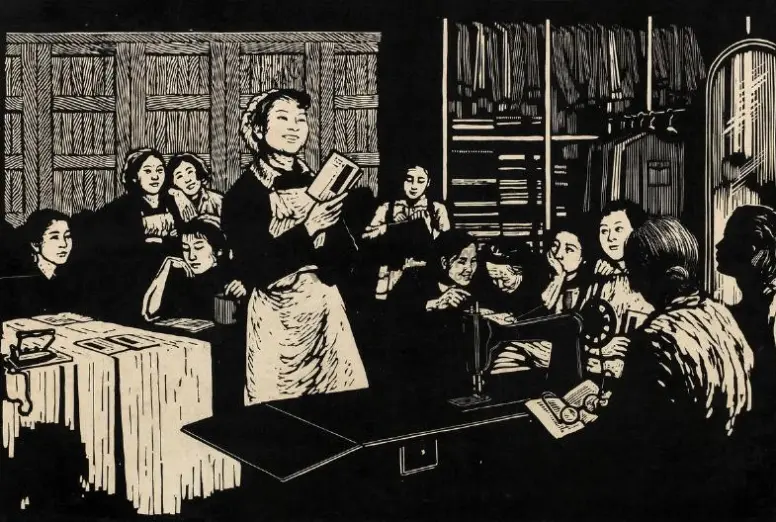
Of course, feminism has played a critical but often erased role in China’s revolutionary history. The emancipation of women was a rallying cry not just for turn-of-the century reformers and revolutionaries who overthrew the Qing empire in 1911, but also for China’s Communist revolution, which culminated in the founding of the People’s Republic of China in 1949. Mao Zedong famously proclaimed that “women hold up half the sky” and the Chinese Communist Party declared that overcoming traditional forms of male-female inequality was an important policy goal. In the years after the revolution, the government publicly celebrated gender equality and sought to harness women’s labor in boosting the nation’s productivity with expansive initiatives that assigned urban women jobs in the planned economy.
Today, however, the Chinese government is only paying lip service to its historical ideal of gender equality; increasingly, women are treated as second-class citizens who should be confined to the subservient roles of wife and mother in the male-dominated household. China’s all-male rulers have decided that—the Party’s revolutionary history of gender equality notwithstanding—the systematic subjugation of women is now essential to maintaining Communist rule. And under Xi Jinping, China’s patriarchal authoritarianism has worsened.
Shortly after Xi became general secretary of China’s Communist Party in November 2012, he gave a pivotal speech in which he explained the Soviet Union’s collapse. “A few people tried to save the Soviet Union; they seized Gorbachev, but within days it was turned around again…Gorbachev announced the disbandment of the Soviet Communist Party in a blithe statement,” he said. “Proportionally, the Soviet Communist Party had more members than we do, but nobody was man enough to stand up and resist.” The independent journalist Gao Yu–jailed several times for her role in the 1989 Tiananmen protests and other criticism–was quick to respond. “ ‘Nobody was man enough!’ ” she wrote. “How vividly this captures Xi Jinping’s anxiety over the fall of the Soviet Communist Party and the collapse of the Soviet Union!” (Note Xi’s conspicuous alliance with strongman Putin.)
Xi’s first major speech as Party leader signaled that, unlike Gorbachev, he was “man enough” to stand up for the Communist Party; he possessed the manly qualities needed to defend China from those seeking to undermine Communist rule. He has since developed a hypermasculine personality cult and in 2o22, for the first time in 25 years, not a single woman was appointed to the Communist Party Politburo.
And it may be no coincidence that women’s labor force participation has fallen dramatically over the past few decades. In 1990, the female labor force participation rate was 73 percent (for girls and women ages 15+). By 2024, women’s labor force participation had plunged to 59.6 percent, according to the World Bank.
In stark contrast to neighboring countries, which introduced policies to get more women into the workforce (eg. Japan’s “womenomics” policy initiated by former Prime Minister Abe), the Chinese government has never indicated any intention of helping to increase the share of women in the workforce since the onset of market reforms. On the contrary, state propaganda under Xi’s leadership has revived sexist elements of Confucianism, in particular trying to push the notion that a traditional family (based on marriage between a man and a virtuous, obedient woman) is the foundation of a stable government.
Much of today’s Communist Party propaganda preaching “family values” harkens back to the Confucian discourse from the imperial era on womanly virtues. Propaganda images depict Xi Jinping as father of the Chinese nation, in a “family-state under heaven” (jiaguo tianxia). China’s official Xinhua news agency ran a long article in 2017 about the connection between Xi’s traditional family values (jiafeng) and national values (guofeng). “The family is the smallest nation, the nation is 10 million families. The ‘family’ [jia] in family values is not just the small family, but also the family in our nation [guojia]…Xi Jinping says ‘little family’ but he has in mind the ‘big family’ [the nation].” The article features a photo of Xi as a filial son, strolling hand in hand with his elderly mother, with stern warnings to “govern one’s family well” and “set strict demands on spouses, children and close colleagues.” Xinhua also restates the frequent Communist Party line that family forms “the basic cell of society” and that “a harmonious marriage is the foundation of a harmonious society.”
Faced with falling birth rates after more than three decades of the draconian “one-child” policy, Beijing adopted a new policy in 2021 of exhorting Han Chinese women to have three children. In 2023, Xi Jinping became even more overtly pronatalist, declaring that China needed to develop “a new type of marriage and childbearing culture” to answer the plummeting birth rate.
Another linchpin of the Chinese government’s systematic subjugation of women is unchecked gender-based violence. According to this logic, women must marry men to preserve social stability, act as obedient wives and mothers in the home, provide an outlet for men’s violent urges, perform unpaid care work, have babies and rear the workforce of the future.
Ten years after Xi’s government enacted an anti–domestic-violence law that made China look more like a responsible global power, the law’s most important provisions—including the issuance of restraining orders against accused perpetrators—have not been properly implemented. Women who seek restraining orders are routinely told to return to their partners to preserve family “harmony” and social stability.
In recent years, it has become much more difficult to get a divorce, which effectively traps millions of women in abusive marriages. As I wrote in my book Betraying Big Brother: The Feminist Awakening in China, keeping the patriarchal family structure intact—even when the woman’s life is in danger—is central to political stability and Communist Party survival. No matter how brutally oppressed a man is by the state, he can always go home or elsewhere and take his anger out on a woman in private with impunity. No matter how low the man is in society, the woman attached to him (whether wife or girlfriend) is even lower. As long as the government continues allowing men to abuse women—in the home or in the workplace—men are more likely to accept a one-party dictatorship.
This strongman authoritarian playbook, built on the subjugation of women and control over reproduction, is of course admired by current U.S. President Trump and the far right around the world. White nationalists in the United States, including Elon Musk, express alarm about “low birth rates” causing the “collapse of civilization”. The Heritage Foundation just published a pronatalist “Marriage and Family Report”, with language that sounds remarkably similar to propaganda from the Chinese government, calling for initiatives like a “marriage boot camp” and saying things like: “The family is the foundation of civilization, and marriage—the committed union of one man and one woman—is its cornerstone.”
Unfortunately, the pronatalist scaremongering in America today is not confined to the far right. National Public Radio recently ran a news story with the headline, “As birthrates tumble, some progressives say the left needs to offer ideas and solutions,” quoting self-identified “progressives” who argue that falling birthrates are a “crisis” for society. At a time when half of America has overturned the right to have an abortion, let’s not fall for the misogynistic, white-nationalist argument that we need to get American women to have more babies.
Unlike China, America is an immigrant nation and a key driver of U.S. population growth is immigration. Mass deportations combined with stricter immigration controls under Trump are the main reason population growth slowed significantly last year. If we want a healthier democracy, let’s fight the terrorizing of immigrants and American citizens like Renee Good and Alex Pretti, who were brutally murdered by ICE agents in Minneapolis. Let’s fight the rise of fascism by opening our borders to more immigrants from around the world.
As we in America look for ways to defend our democracy under threat, we can draw inspiration from the resistance of young women in China.
In 2022, China’s largest protests against the Communist Party since 1989 spread from one city to another, calling for an end to the government’s draconian “zero-covid” policies, in what came to be known as the “white-paper movement”. A striking number of young women appeared on the front lines of the protests, whether standing alone to hold up a sheet of white paper, leading the crowd in chants, or confronting police officers who dragged them into waiting vans. Less than two weeks later, Beijing lifted the unpopular policies. Even in the world’s most powerful autocracy—with no press freedom, no internet freedom or freedom of assembly, and effectively no rule of law—organized resistance can succeed.
Can America, this immigrant nation, save our multiracial democracy? Yes we can, by protecting the rights of all those most marginalized in our society. If we come together to fight misogyny, racism and anti-immigrant bigotry, we will win.