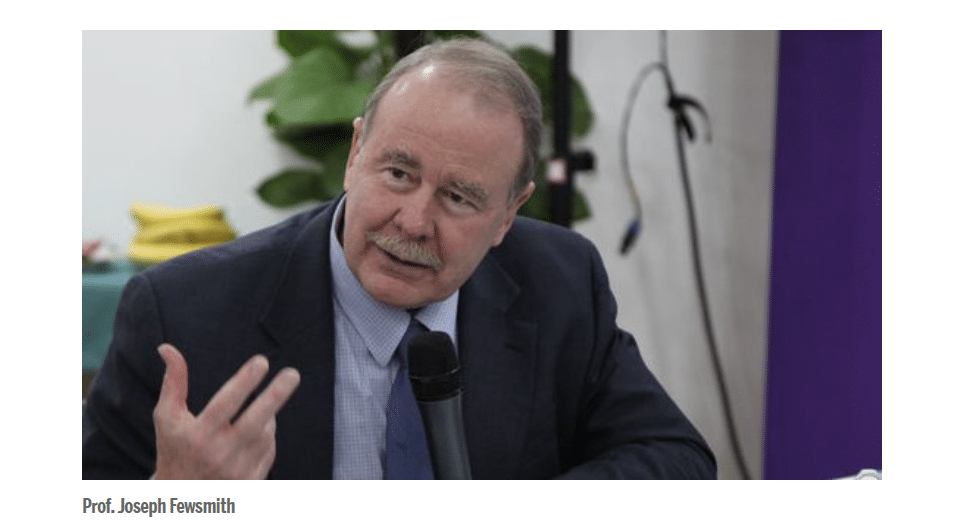
Earlier this month, while traveling in Thailand, I was stunned to learn of the passing of Professor Joseph Fewsmith. He was only in his seventies—an age that no longer feels old—and his death came as a shock to many who had long viewed him as one of America’s most perceptive observers of Chinese politics.
I had known Joe for nearly three decades. While many memorial articles have already appeared, I offer here a more personal remembrance—set against the broader sweep of an era in U.S.–China scholarly exchange that is now quietly fading away.
Harvard Memories: Encounters With a Generation of Masters
My connection with Joe began in 1997–1998, when I spent a year at Harvard as a Harvard–Yenching visiting scholar. That year allowed me to meet some of the most influential American scholars on China: Lucian Pye, Roderick MacFarquhar, Ezra Vogel—and Joseph Fewsmith, the youngest among them.
Pye, born in 1921, was already a political science titan by the time I first encountered his work as a student at Fudan in the 1980s. MacFarquhar, the author of The Origins of the Cultural Revolution, was revered for his deep archival contributions. Vogel’s Deng Xiaoping and the Transformation of China later gained him immense popularity in China, but even before that he stood at the apex of East Asian studies.
Compared with these giants, Joe was then in mid-career, not yet widely known in China. Before meeting him, I had never heard the surname ‘Fewsmith . But he impressed me immediately: he introduced himself with humility, invited me to lunch, and—unlike many foreign scholars—spoke Chinese fluently and understood the importance of sharing a meal in Chinese culture. We became friends quickly.
During my Harvard year, I witnessed firsthand how deeply he understood China. His grasp of elite politics was, and remains, unmatched among American scholars I have met. When he asked me questions about China, I often felt he understood details that even many Chinese scholars overlooked.
From those early encounters, Joe steadily rose to become a leading authority on contemporary Chinese politics. While elite politics as a research field may not have been fashionable in U.S. academia—where state–society frameworks or political economy often take precedence—Joe believed that understanding China required attention to the informal rules, personalities, and unwritten norms that shape political life. On this point, he and I shared many similar insights.
Around 2011, Joe visited China and met with me. When the topic of China’s leadership succession system came up, I was cautious and spoke vaguely, sensing its sensitivity. Yet he clearly articulated the concept of an “intergenerational designated successor” system, which once again amazed me with his grasp of Chinese politics—at that time, even many domestic scholars had little understanding of it. Of course, this so-called “system” later proved to be quite fragile.
It was for this reason that, more than a decade ago—when many still believed that Chinese politics was becoming increasingly institutionalized—Joe remained skeptical. In his view, China’s political system was entering a new period of constant change and flux. He placed particular emphasis on the informal nature of Chinese politics rather than its institutionalization, which aligns closely with the core argument I made decades ago in The Governmental Process, where I distinguished between institutionalized and personalized political authority in China.
Notably, around 2012, when some believed that retirement norms for Chinese leaders were becoming more rigid, Joe predicted that the system would in fact retain significant flexibility. He also foresaw the possibility of a return to ideological politics. These observations demonstrated his remarkable insight.
In the United States today, there is a growing consensus that the country has been “getting China wrong.” Scholars of the older generation like Joe inevitably feel disappointment and regret. Yet they remain steadfastly friendly toward China—the more pointed their critique, the deeper their affection.
Will there be another younger generation of China experts in America like Joe?
A Farewell to an Era
Healthy relations between nations ultimately depend on healthy relations between people. Among these interpersonal bridges, academic exchange is especially crucial. Scholars like Joseph Fewsmith may not share China’s values or political views, yet they cared deeply about the country. The mainstream among them always hoped China would succeed—at worst, they felt a kind of tough love, a frustration born from high expectations. In today’s tense and polarized U.S.–China environment, it is all the more admirable that a dwindling number of these “China hands” continue to advocate for engagement and dialogue, even if they are powerless to reverse the broader geopolitical tide.
Top universities can play a central role in sustaining international academic exchange. Harvard, for example, functions as a global hub—not only because it attracts top scholars, but also because academics and officials from around the world naturally gravitate toward it. During my year there, I met not only the China specialists mentioned earlier, but also attended lectures by Samuel Huntington, one of the most influential American political scientists; interacted with Joseph Nye, the dean of the Kennedy School and the father of the “soft power” concept; engaged regularly with Tu Weiming, the leading figure of New Confucianism; and participated in events involving President Jiang Zemin and General Xiong Guangkai during their visits to Harvard.
Harvard is a place where global elites converge. In the field of China studies, the Fairbank Center has long been a major powerhouse. Many prominent China scholars from across U.S. universities and research institutes are affiliated with it—Lucian Pye, for instance, was a professor at MIT, and Fewsmith taught at Boston University, yet both were research associates at the Fairbank Center. The ability to encounter world-class scholars across disciplines is something few institutions can match.
Joe traveled to China countless times throughout his career. But after the pandemic, he never returned—and now, he never will. If scholars stop crossing borders, if universities let intellectual and cultural exchanges atrophy, and if stepping outside one’s own country becomes difficult, the situation becomes truly dangerous.
My most recent trip to the United States was in May 2015; it has now been a full decade since I last visited. At that time, I had just moved from Shanghai Jiao Tong University to the Shanghai Party School. The Party School was still relatively open, and U.S.–China relations were still normal enough for academic exchange to continue smoothly. I went to participate in the inaugural U.S. session of the World Forum on China Studies. At the conference hosted by the Carter Center, Joe and I co-chaired one of the panels. Jet-lagged and half-asleep, I struggled to stay focused; noticing this, he took on most of the moderating responsibilities, sparing me from embarrassment. I have never forgotten that kindness.
Joe’s passing symbolizes the end—or near end—of an entire generation of American “China hands.” The era of a constructive strategic partnership between China and the United States is over, replaced by strategic competition that neither side can easily step back from. The period when the American academic community was broadly friendly toward China is also gone, and cultural and scholarly exchanges now face obstacle after obstacle. What the younger generation of American scholars feels toward China is unclear to me, but it is hard to imagine another figure emerging with Joe’s depth of knowledge, emotional connection, and long-term commitment to understanding China. That is a cold reality we must face—and the reasons behind it deserve serious reflection.
I truly miss the earlier era.
This article is offered as a tribute to Professor Joseph Fewsmith—a scholar, a bridge builder, and a friend.