
The Carter Center is honored to feature an interview with Dr. Tani Barlow, a foundational scholar in the study of Chinese women and gender. In this conversation, we explore the significance of feminism in modern China, tracing a long and complex intellectual history that connects Ding Ling, the Modern Girl, revolutionary feminism, Maoist gender politics, and contemporary activism. Drawing on material from her book In the Event of Women, Dr. Barlow explains how womanhood has been defined in China, why those definitions matter, and the intricate relationship between gender and modern Chinese history.
The interview also weaves in Dr. Barlow’s reflections on her distinguished academic career. For readers interested in 20th-century Chinese history and the evolution of Chinese feminism, this interview offers historical perspective and fresh insights alike.
Tani Barlow is George and Nancy Rupp Professor of Humanities, Emerita Professor of History at Rice University, and Visiting Professor in Department of Asian and Middle Eastern Cultures at Barnard College. Her research focuses on Chinese intellectual and women’s history. She is the author of In the Event of Women (Duke University Press, 2022), The Question of Women in Chinese Feminism (Duke University Press, 2004), and Inter/National Feminism and China (Ito Ruri and Kobayashi Eri, trans.; Tokyo: Ochanomizu Press, 2003). Professor Barlow is the founding senior editor of positions: asia critique, an international, five-time prize-winning journal. Barlow is also co-founder of the Chinese Commercial Advertising Archive (CCAA) with Professor Chen Jing of Nanjing University.
Alice Liu: Pleased to have you here today, Dr. Barlow. If you don’t mind, let’s begin by chatting a little bit about your personal life. I wonder what introduced you to the field of Chinese feminism.
Tani Barlow: My family has a long interest in China. It started with my great-uncle Claude Heman Barlow, who was a medical missionary in Shandong Province, and then in 1947, my father Claude Abner Barlow spent a chaotic year in China with a post-war relief organization. I was born and grew up after Liberation, when it wasn’t possible to visit China. Still, I always heard about how important China was and that the farmers had had a revolution, important to my father because his family were Midwestern farm people.
When I was young in the ‘Sixties, I got involved in women’s liberation struggles. That was generational—most people I knew were caught up in the feminist movement and the civil rights movement. I also grew up in Palo Alto, California, a very liberal enclave. Early in my life I was drawn to philosophy, logic, and criticism, which naturally led me to feminist theories. In college, I balanced these two interests, studying the Chinese language and intellectual history.
When I got to graduate school, I already knew what I wanted to do, and that was to study the writer Ding Ling. She was known to be a progressive May Fourth writer, and I fell in love with her work. Some articles had described Ding Ling as a so-called “anti-Communist element,” but I read her “Thoughts on March 8,” a Women’s Day piece published in 1942 in Yan’an, and found it to be not anti-Communist at all but a pro-feminist document. I wanted to do a dissertation on Ding Ling. At that time, many dismissed her as a mediocre writer because she was a socialist and a revolutionary.
AL: Is she mediocre?
TB: Not at all; she’s a great writer. In ways she resembles African British novelist Doris Lessing (1919-2013) and U.S. radical writer of fiction and non-fiction writer Tillie Olsen (1912-2007).
Another important part of my life was a great romance with my husband, a refugee Chinese scholar. Later when it became possible for us to travel to China, we spent a year at Shanghai Normal University. I was able to meet Ding Ling, which compounded my desire to finish the dissertation.
I wanted to understand Ding Ling’s broader intellectual context. What made her writing distinctive, and what were the positions she took, and why? Still in graduate school, I gave a talk in Paris at the invitation of German Professors Wolfgang Kubin and Rudolf Wagner, who were leading an effort to rehabilitate Chinese revolutionary female writers. Our talks were published, my first publication, and it launched my career.
It allowed me to contribute to Ding Ling’s biography. I edited a volume of her works and introduced Ding Ling to English-language readers in a volume titled I Myself Am a Woman: Selected Writings of Ding Ling with the help of Gary Bjorge, who had just finished a dissertation on her fiction.
I decided not to publish my dissertation and to expand my project. Around that time, I met Joan Scott, a then-leading theorist of gender history, who liked my work. She collected my first silver-bullet article, “Theorizing Women,” and that made me legible to other historians outside the China field.
That essay asked a question: Why are there three words for “woman” in the Chinese language and not in the English language? That question shaped much of my early scholarship. Starting from there, I wrote the book The Question of Women in Chinese Feminism, a history of twentieth-century Chinese feminism. The Ding Ling chapters are an important part of that history.
AL: What are those three words for “woman”?
TB: The first one was nüxing, which appears in May Fourth literary texts. But since I was a student of Chinese, I knew that funü also is translated as “woman,” nüren, too.
I remember reading texts and gradually realizing that in the eighteenth-century Confucian scholars used funü as a way of categorizing womanness. And the more I thought about that, the more I figured, this is strange. What does funü mean? It means women in the family. It means all those kin groups who are inside the family. And then I thought to myself, okay, so where is a word that means “biological women.” Until the 20th century, there was not a word to say that or to define female commonality as anatomical.
In modern Chinese xing can mean sexuality or sex. I found the neologism nüxing, a modern word, in sexual science translations. Chinese intellectuals interested in sexology translated texts that spoke to them. Including one by American sociologist Lester Ward called “Our Better Halves,” which Chinese translators retitled Nüxinglun or “gynecocentric theory,” because Ward proposed that in human evolution women did sex selection and chose male partners, not the other way around. So, when I found this Chinese document, I thought to myself, when the translator uses nüxing instead of funü, they are indicating an important linguistic shift.
I read many documents to find an answer to the question of how these terms worked. The issue of “ren” or “nüren” primarily showed up in texts that were about social science, and I think it was a less important term than funü and nüxing. Nüxing turned out to be a neologism, a new word, meaning the female sex.
I was also able to show how funü was adopted by the Chinese Communists. When talking about women as a category, they used funü. That’s partly because in the Chinese Communist Party, women were in kin-like relations to each other; they called each other “elder sister.” I identified the interior of the women’s movement in the Communist movement as being very much related to reestablishing modern funü, whereas it’s the modern girl—the sexual liberation wing of the anarchist movement—that is all about nüxing.
AL: Is that so? Are the modern girl image and the anarchist movement interrelated?
TB: Yes, in a historical sense. The modern girl for me was all about the relationship between sexual liberation—which the anarchists talk about—and the commodity form, which they also criticized.
I got tipped off to this when I read an essay by Mao Dun in which he wrote, in English, “Ding Ling is a modern girl.” That’s the first time I had ever seen that phrase, “modern girl,” and I thought, what is this? I had also encountered sexy girl images in small commercial commodity advertising, so I started to ask myself, was Ding Ling like this? And the answer was yes, to the degree that she problematized the relationship of free women and commodity culture, she participated in the modern girl phenomenon.
Throughout that research, I was interested in how Ding Ling went from writing about desire in the new culture of Chinese treaty ports, particularly Shanghai, to becoming a Maoist, since I had also discovered that she was deeply loyal to her vision of communism, which at times pushed Maoism in directions that other Maoists found unorthodox, such as her unrelenting preoccupation with women’s liberation.
Of course, she got into lots of trouble. She wasn’t somebody to stay quiet; she was an explosive person, yet her loyalty became legendary. It took me years to figure this out, but it seems to me now that Ding Ling discovered a truth: that women are desiring, contradictory, conflicted social beings, and she was willing to shame herself in public to express her vision.
For her, women, like men, are full of passion, struggling along the road of life to become a real person. She remained loyal to the insight that women are people. When she joined the Communist movement, she started thinking, okay, we are revolutionaries seeking to change the world to make it good for people like ourselves and for women as a social group. In my language, Ding Ling became loyal to the event of women through communism.
AL: Can you tell us briefly which historical eras you looked into in this book?
TB: For In the Event of Women, I laid out what I believe are the conditions for thinking about women’s liberation in chapters on political economy, advertising culture, and Marxist feminist high theory before the Liberation and then ended the book in the Cultural Revolution. I looked at Ding Ling and her peers in the Seventeen Golden Years and then in the various Maoist revolutions and did primary-source research to see how Ding Ling became an enemy of the people, what the grounds were for the attack on her, and then why she was rehabilitated.
That led me to Wang Guangmei, who fascinated me and I realized that Wang Guangmei’s biggest antagonist was Jiang Qing, so I started looking at Jiang Qing.
AL: What about these two women?
TB: Jiang Qing was the fourth wife of Chairman Mao, an actress from a poor background. The Shanghai movie industry was a pretty shady place; there was much commercial sex involved.
Jiang Qing became a leftist and gravitated towards the Communist movement and ended up in Yan’an, where she fell in love with Chairman Mao, who reciprocated, but the Communist Party (CCP) leadership was not happy. The reason they allowed the marriage was a promise that she not be involved in politics. She became Mao’s partner, mouthpiece, and fangirl.
When the Left Maoist faction began developing the Great Proletarian Cultural Revolution (GPCR), she joined the “Gang of Four.” And as Mao threw himself into GPCR, began destroying things and hurting people, she was, along with other Gang members, empowered to do the same thing.
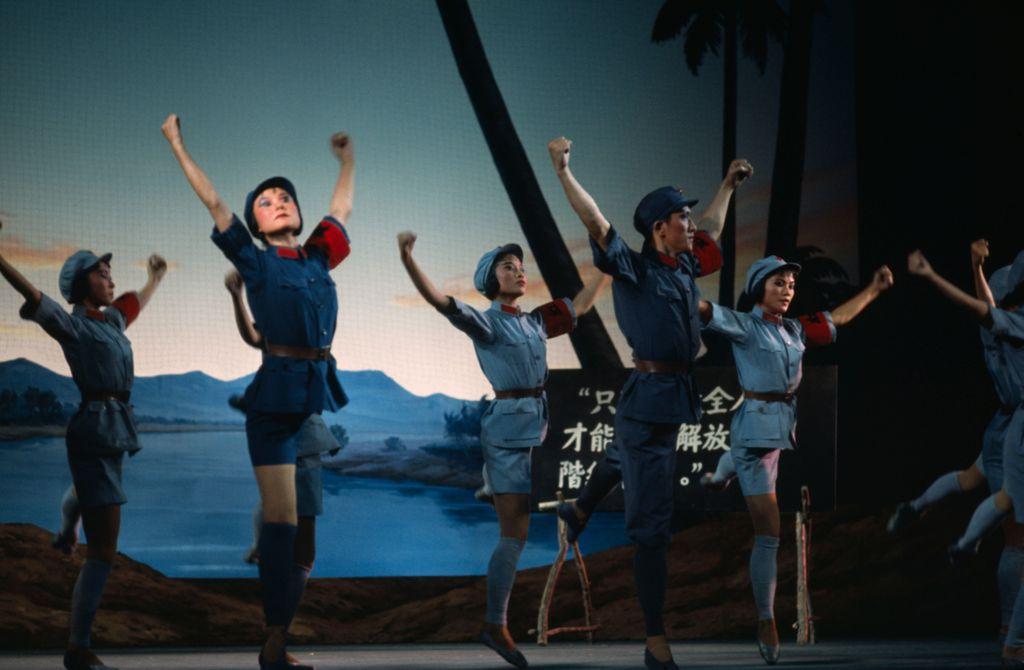
Jiang Qing became a powerful force in the world of Chinese revolutionary cultural politics. Her involvement in writing and staging plays and operas had begun before the Cultural Revolution. We know now how complex a person she was because younger scholars are taking her seriously and writing about her. It may be that she felt underappreciated early in life, but there is so much about the motives for violently struggling against other high-ranking officials not fully understood yet. We do know how she was vilified in the post-Mao regime, that she got the death sentence for her acts, and that she killed herself in confinement.
AL: And why did she have beef with Liu Shaoqi’s wife?
TB: Okay, this is my argument. I noticed that the trial of Wang Guangmei, Liu Shaoqi’s wife, was a public spectacle. I had photographs of it, and then a transcript. Somebody released it to me, the transcript of the interrogation of Wang Guangmei by the Red Guards before they forced her onto the stage to be criticized and “struggled against.” That transcript is easily available now but had not yet been released when I was doing my research back in the day.
I realized that they had dressed her like a modern girl. The political charges against her were something like this. You are a criminal because you did “wife diplomacy”, and you were wearing a close-fitting dress, a clochehat and a bob haircut; you looked at Hollywood movies; you wore lipstick and makeup, and Jiang Qing had instructed you to wear a brooch, but you wore pearls instead. The charges circled around a modern girl look, which, during those repressive times, became iconic of sexual looseness. The Gang was accusing the First Lady of dressing like a prostitute.
Historians have long written about how public figures represent the nation. During Barack Obama’s presidency, right-wing agents attacked Michelle Obama, saying how she looked like a man because she worked out and had muscular arms. We know accusing African American women of being too big, too masculine, or too muscular is an old, old trope in racist culture, but the point here is that Wang Guangmei got attacked for being too bourgeois and too feminine. (If you are female in public, you can’t do anything right!)
One reason Jiang Qing attacked Wang Guangmei was to show that the women of China are revolutionaries who don’t care about lipstick, so there’s a direct conflict over who Chinese women are or are supposed to be.
As an aside, writing women’s history at this level means engaging with struggles that seem trivial on the surface. Tani Barlow writes about Wang Guangmei. Why should I pay attention to the wives of powerful men since they are just dependents, suck up to men, do whatever they are told to do, etc.? I had to convince my reader that this was an important political cultural conflict.
But that’s not all it was. It was also a policy dispute. I will not talk about the “two-line struggle” between the Liu Shaoqi and Mao Zedong factions inside the Chinese government, although that was much of it. The other was women’s policy. What kind of Chinese women get to hold up half the sky? Why can’t Wang Guangmei wear lipstick and hold up half the sky at the same time? What’s wrong with that?
For the ultra-left side, bourgeois femininity is capitalistic; modern girl-style women are the playthings of men, and Wang is nothing but a plaything of Liu and Sukarno. My job was to analyze the conflict as a historical fact, and that’s what I did.
AL: I love it. So that’s what you meant by saying they’re both loyalists to the event of women.
TB: Yes, exactly. I argued that Wang Guangmei and Jiang Qing were having a violent political debate over what Chinese womanhood is. Because Wang Guangmei says, “In your face, y’all, I’m every bit a woman, a patriot, a Communist, and a fighter as Jiang Qing is. I just express it in a different way. I am a high-ranking Communist. My job was to light Sukarno’s cigarette. I did my job. Now you tell me that it’s not my job. But it was, “I held up my part of the bargain, and I myself am also a woman.”
Then Jiang Qing says, “nah, you are a big ho, a prostitute. You played up to Sukarno when you went on a state trip to Indonesia. You didn’t go and see the Communists. You were flirtatious and you presented yourself as a femme fatale. That is counter-revolutionary, and by the way, you cannot represent the women of China this way.”
In a sense we’re still having that fight, right? I am a lipstick feminist. I’m a feminist who loves makeup, hair, and fashion. Some of my friends think that’s trivial, but they also think now, after decades of struggle, that I’m just a different flavor. In your generation, it is my impression that feminists come in every package imaginable.
AL: About this part, you describe women as a “testing apparatus of Chinese modernity” from the late Qing to Maoist China. Elaborate on it for our readers, if you will.
TB: This claim is rooted in decades of research in international women’s history, beginning in the nineteen eighties and nineties in the United States, and particularly the Transnational Women’s Studies movement led by people like Professor Inderpal Grewal and Professor Caren Kaplan. Kaplan established the women’s studies program at UC Berkeley, Grewal ended up at Yale, and they launched a scholarly project they called Transnational Feminist Studies.
All of us lived in the Bay Area at the time. Grewal, who was of Indian-Punjabi origin, taught in Women’s Studies at San Francisco State College while I taught in the History Department there. We established long-term reading groups and noticed that some of the things we thought were special about, say, the situation in India, Egypt, Pakistan, or China turned out to be international.
One commonality was what during those years we knew as “colonial discourse.” In the late 19th century and into the 20thcentury, European- and American-educated, new-style intellectuals became the modernizer generations all over the colonial world. The study of these Indian modernizers took off, and we read books about how they learned ideas, philosophy, medicine, the social sciences, and the natural sciences in London, Cambridge, Oxford, Ithaca, or Chicago and, arriving back home, had founded schools and universities to teach new knowledge to elites in their countries. A second commonality we found was that this largely male scholarly community took on the idea that the measure of a civilization is how it treats its women.
This is easily illustrated in Indian history. Colonial occupation lasted for two centuries and enforced the idea that the British are in India to civilize people and to rescue Indian women from Indian men. People like feminist theorist Chandra Mohanty and historians Lata Mani and Shefali Chandra established the ambivalence that this caused; over time the proper Brahmin wife became a bilingual woman whose native language was English. English because the elites in India were British subjects. This profoundly complicated what a nationalist like Gandhi thought about Indian women’s liberation would be.
We see a similar pattern in China, where progressive scholars who advocated reform and revolution, like Kang Youwei (1858-1927), Liang Qichao (1873-1929), Sun Yatsen (1866-1925), Qiu Jin (1875-1907), He-Yin Zhen (1884-circa 1920), Jin Tianhe (1874-1947) and so on, struggled with Western imperialism and its norms for women. We see it again after the founding of the Republic of China in 1912 in the May Fourth Movement of 1919. This was a youth movement, so exactly the kinds of people who wanted free-choice marriage to women who were peers and equals; boys and girls who chose companionate love in marriage.
Women’s liberation theory and policies appear in the nationalist revolutionary movement, in the Nationalist Party of Guomindang, and among female martyrs of the 1911 Revolution and continue into anarchist and Communist ideology, which is why you see Chinese Marxists like Qu Qiubai being feminists. Much to the frustration of people like Ding Ling, these communist men are feminists mostly in word, not in action.
The national situations are analogous but vastly different. I would read and discuss movements in a colonized region like India, where nationalists militated for women’s equality under law, and then I would go to Chinese sources and ask myself, Do I see the same thing here? The answer was yes at times. In the ideology of the Taiping Civil War in China (1850-1864) there are Daoist tendencies, ideas, and practices originating from indigenous cults and, significantly, foundational ideas about religious equality, women having a soul just like men. The point is that nationalists of all these anti-imperialist, anti-colonial movements agreed that national liberation would involve modernizing women. They saw that in the eyes of the imperialists native women were oppressed, so one of the ways to test the degree of a civilizational improvement would be to test the status of women under native government.
A problem was that declaring that women have rights under a national government after overthrowing an imperialist or semi-feudal, semi-colonial government did not solve the problem. It unleashed new ones. Women’s movements, revolutionary in their time, did not anticipate outcomes. Plus, women’s movements tend to scare people.
Let’s say the Nationalist or Communist Party liberates women from a big or feudal family system and lets them choose their husbands; what else are they going to want to choose? Not to get married at all? Or looking at things from the progressive point of view, are love marriages better than arranged marriages? What happens to women who choose a spouse if the marriage fails? If that happens, how can the society resolve the problem of family formation?
Or take the problem of governing the state after promising your female citizens that you will liberate them? What does the state say to women? We represent you politically. We have Fulian, the Women’s Federation, which is a state bureaucracy. It is an organization established to serve you, but the government controls it. The tension between state development planning and the needs of women becomes tortured. Take for instance a woman who says, “I want you to execute my husband because he beats and rapes me every night,” and Fulian, who might, with every reason, say, “No, we can’t do that because, well, it’s against the law. But also, your husband is the Party secretary in your village. We need him.”
AL: How did you come to study Republican-era commercials? And what do they testify about Chinese feminism or Chinese women in society?
TB: It happened while I was writing my first book. I was using periodicals like Dongfang Zazhi and a lot of different magazines, which had full-page advertisements in them, and they overwhelmingly showed pictures of women enjoying modern commodities. These ranged from cosmetics and soaps to cars and perfumes and later food commodities. And so I said to my colleagues in the late nineties, “I’m really interested in these advertisements, so let’s focus on international advertising since it is a visual language and does not require everybody to learn Hindi, German, etc.” That laid the foundation for the Modern Girl collaborative project.
Just then I went to Tokyo to the Institute for Gender Studies (IGS) at Ochanomizu Women’s University as a visiting research professor. IGS had Japanese federal grants to internationalize scholarship in women’s history and feminism. Obviously, I found compatible Japanese researchers there and involved them in the advertising problem and the question of what the modern girl meant historically. In both groups, we found that the same companies were advertising the same products all over the world. Collecting was the first step. We saw Palmolive soap being advertised everywhere, but my next question was, why? The answer is that global multinational corporations founded at the end of the nineteenth century and the beginning of the twentieth, like Unilever or Jintan or General Electric or Doan’s Pills, planned to expand into colonial markets. China’s treaty port system was one of them.
And that is why I was seeing foreign products advertised in Chinese journals of opinion for highly educated elites. At first, I did not know what to do with this information because that’s how historians work. But connecting advertisements and tracing them backwards led our groups to publish two major edited volumes, The Modern Girl Around the World2008 and The Modern Girl and Colonial Modernity: Empire, Capital, and Gender in East Asia (モダンガールと植民地的近代:東アジアにおける帝国・資本・ジェンダー) 2010. I still get letters from people saying, “I want you to read my modern girl study of Burma” or “modern girl study of Peru,” or “Did you know that in Leningrad …?”
So, it’s all over the world, and people still research to find out what the specific politics and history of modern girl advertising and actual women who bought these products are and what that local history looks like. How advertising connected to modernism in Chinese advanced sector treaty ports in the first half of the twentieth century turned out to involve class differences; questions about hygiene and biology; investigations into modern gynecology as well as fashion; education for girls and women; and the big change that capitalist commodity culture brought to relations between boys and girls, men, and women. Advertising is a mirror. Plus, it triggered anger and criticism over how ad culture sexualized women’s bodies. This would be part of the struggle between Jiang Qing and Wang Guangmei that we discussed earlier.
AL: What would you say are the differences between early New Woman movements and feminist activism today in China?
TB: Strictly speaking, the New Woman movement was nationalist and feminist and included people like Ding Ling’s mother, Yu Manzhen, who changed her name to Jiang Shengmei (1878-1953). He Xiangning (1878-1972), Qiu Jin (1875-1907), Lü Bicheng (1883–1943) and many others who are considered new women. They believed themselves the equal of men potentially, but they had to work hard to get educated, unbind their feet, and get physically fit enough to struggle for national liberation.
The second wave of women activated feminism breaks out during the May Fourth or New Culture generation, roughly 1919-1937. Of course, many of them are still nationalistic, but generationally, the new feminists were taking on Darwinism, Marxism, anarchism, liberalism, empiricism. These were international human sciences and brought into scholarly and political life fresh ideas about sex difference and gender. Educated men and women started writing for fashionable scholarly political journals like New Youth, and journals of opinion like Eastern Miscellany and The Ladies Journal. The fundamental question shifted in this era from how am I a national citizen to who am I as a woman? The journals filled up with personal testimonies like, “I was married by my parents to my traditional wife, and I demanded a divorce, and now I’m in love with somebody else, but I’m a divorced man. I feel terrible stress and anxiety” and so on.
You could say that May Fourth feminism caused problems in my own family. My husband, Donald Mingdah Lowe (1928-2009) had an uncle (my father-in-law’s brother) who had been married to a country woman but then came to the United States for education and fell in love with a white woman. (I think it was that uncle; there were a lot of brothers.) In any case, this man rejected his first wife but insisted that the family keep her on as legitimate kin and that woman lived as a Lowe the rest of her life. May Fourth generation were still bound by filial obligations, but they wanted their own lives, and many were feminists in the sense of demanding civil rights for women. The foreign wife (Ruth Earnshaw Lo) was well educated; the traditional wife was not. Ruth was a companion and she came to China and stayed there for forty years. Acting on feminist ideas was complex for this generation. To upset your parents and refuse something your parents want but to take care of your parents anyway is one of the many stresses of the May Fourth generation. They were pulled in different directions.
For the socialist period, communist feminist iron girls are famous, right? It was a real phenomenon. Although the number of women admitted into the Communist Party during the Cultural Revolution increased, researchers in the PRC and the U.S. believe female membership only reached 13 to 15% of the cadre corps, meaning overwhelmingly the revolutionary government was male. Research on this question began in 1995 and continues. The GPCR surge appears to have been a pretty meager “high tide,” but the post-GPCR reaction against even those gains was immediate and strong. Once the Cultural Revolution ended, women got kicked out. Beyond women’s political representation at the state power level, scholars have established a factual basis for understanding retrogressive policies and the growing burden—social reproduction, double shift of homework and paid work, political ostracism, hiring discrimination, etc.—that accompanied the “reform and opening out” policies we call neoliberalization. Paradoxically, elite education gives women opportunities never before possible while discrimination in hiring forces many out of the labor force. Not paradoxically, women’s movements and feminist theory have increased over the last years.
AL: And why that switch immediately after the cultural revolution?
TB: Social, economic, and historical forces are factors. This may be the reason women’s liberation will be the longest revolution of all. Male dominance remains a problem rooted in the core social institutions that support us all: family, social class, conventions about emotional and erotic expression, and so on. Currently some feminist philosophers argue that the family must be “abolished.” What they mean is that care, the labor of taking care of even the people we love, must not land on women in families but must be socialized. Keep in mind that this is not a Chinese problem. The question of women’s liberation is fought in the United States, as in most parts of the world. Let me share a personal story.
When I arrived at Rice University, I came as an administrator and an established scholar. One semester I was appointed to a presidential-level committee. Most of the men ignored me, but one started lecturing me. He was from the STEM division and explained things to me as though I were a child. After gently explaining to him several times that I already understood the parameters of our task, I finally had to say directly to him, “Colleague, I am in this meeting for the same reason you are, representing Rice University, and I already know all of this. You need to stop “helping me”. I immediately became the problem!
The higher you climb, the more insidious it becomes, and you must pick where you want to fight, which is why I admire your generation of young Chinese feminists: so well organized and focused. I work in groups of different ages, assistant professor and associate professor level, as well as non-academic professional women, organizing to demand better treatment and create a demographic profile. We are still working towards the goal of women’s liberation. We don’t know what that’s going to look like, and neither do you. We will find out together.
On that note, maybe we can rethink the old cliché that women have no country, because while it isn’t true, it is handy. Feminists benefit from knowing the histories and traditions of struggle that other feminist organizations and individuals have established all over the world. In that respect, my work is an international project about a remarkable social, intellectual, and political movement rooted in China that is ongoing to this day.