
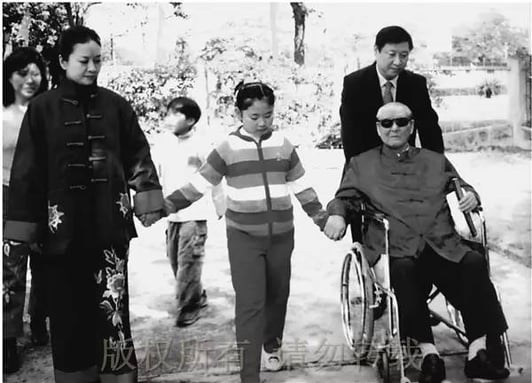
Xi Jinping’s leadership is determined by his early life experiences and his family legacy. The twentieth century has instilled in him two contradictory political lessons. The catastrophe of the Cultural Revolution alerted him to the dangers of ideological excess and made him wary of utopian radicalism. Yet at the same time, the collapse of the Soviet Union inculcated in him a firm belief that ideology is indispensable for the Party’s survival. Dr. Torigian argues that today’s Xi is an “idealistic pragmatist” who, within a highly realist framework, seeks to cultivate a sense of mission for the regime.
Dr. Joseph Torigian is an associate professor at the School of International Service at American University in Washington, a senior fellow at the Council on Foreign Relations, and a center associate at the Lieberthal-Rogel Center for Chinese Studies at the University of Michigan. His book, The Party’s Interests Come First: The Life of Xi Zhongxun, Father of Xi Jinping, was released with Stanford University Press in June 2025. It was a Financial Times Book of the Summer and an Economist Best Book of the Year so far.
Previously, he was a research fellow at Stanford’s Hoover History Lab, a postdoctoral fellow at Princeton-Harvard’s China and the World Program, and a Fulbright Scholar at Fudan University in Shanghai. His work on Chinese and Russian politics and history has appeared in outlets such as the BBC, The Economist, and The New York Times, as well as in journals including Foreign Affairs and Foreign Policy.
Alice Liu: You suggested that, in this piece called Historical Legacies and Leaders’ Worldviews, Xi Jinping’s generation experienced both the chaos of the Cultural Revolution and the ideological disillusionment that followed. What lessons do you think Xi personally drew from the Cultural Revolution?
Joseph Torigian: I think that Xi Jinping, in his formative years, learned about the dangers of caring about ideology too much and also of not caring about ideology enough. I say that because the Cultural Revolution was a disaster. It was profoundly disillusioning for people of Xi Jinping’s generation who had spent the early years of their lives believing that they were building a utopian society. When it became clear that Mao’s agenda had failed, it really shook them. Xi himself admitted that when he was exiled to the countryside during the Cultural Revolution, he was shocked by the poverty he witnessed and realized that the radical, persecutorial mindset of struggle he had brought from the capital simply wasn’t appropriate for the complicated situation in the Chinese countryside.
Then, in the 1980s, the country began moving away from the radicalism of the Mao era, but that prompted reflection on consumerism, materialism, and a crisis of value system. Xi said that, despite everything, he believed that a meaningful life was one devoted to the Party. That made him somewhat different from other people of his generation who decided that they wanted to make up for lost time in various ways, such as making money, pursuing art, or even embracing a more religious life.
AL: You wrote that Xi came out of early life with a mixture of idealism and pragmatism. What did you mean by that? How does that combination manifest in his leadership?
JT: We often think of ideology and pragmatism as a binary: ideological people aren’t practical, and practical people aren’t ideological. But if we look at Xi Jinping and other members of Leninist regimes, such as those in the Soviet Union, we find that these hardcore believers nevertheless can display a wide range of tactical flexibility when the moment requires it.
I say that Xi Jinping is ideological because he believes that if you don’t have a sense of idealism and conviction, then the Party can’t survive, and that you can’t convince people to sacrifice in ways he finds necessary. He also has an ideological view of the contest with the United States. He certainly believes that China’s social system is better than in the West, where he sees materialism and not a real democracy but just a place where people with money can dominate.
But he’s also very pragmatic. Xi has expressed disgust at utopian politics, describing how what he experienced as a young person allowed him to see the fickleness of human nature. He saw, through the Cultural Revolution, that when you pursue agendas that are too ambitious, it can become a complete disaster.
AL: Let’s talk about ideology. You argue that ideology plays an important role in Xi’s administration. Why does he place such heavy emphasis on ideological discipline within the Communist Party today?
JT: For Xi Jinping, he believes that even though the Cultural Revolution was a disaster, after the death of Mao—even though it wasn’t a deliberate strategy—the Party in practice moved away from its struggle mindset in ways that were dangerous. Xi Jinping, who is worried about various kinds of risks, believes that is something that needs to be changed. He thinks that the Party needs to return to its roots and use this idea of self-revolution to prevent itself from becoming a bureaucratic class that’s divorced from the masses and serves its own interests without a real sense of mission.
AL: How does his approach to ideology differ from that of earlier Chinese leaders, his predecessors such as Hu Jintao, Deng Xiaoping, and Wen Jiabao?
JT: A lot of people have said that Xi Jinping marks a radical departure from the Hu Jintao era. But I think that we saw a lot of the hardline tendencies already during the last years of the Hu period. Part of what we’re seeing now in Xi Jinping’s China is a further affirmation of those earlier trends.
And so, we certainly see different periods of openness and closeness in China, but it’s always been a country governed by the Chinese Communist Party. I’m a person who tends to emphasize the continuities in party policy as opposed to discontinuities. As for Xi Jinping, what he’s been trying to say is that it’s not so much that people before him were wrong; it’s that they wanted to achieve certain things but couldn’t, and he’s finishing the job.
Xi has argued that people didn’t want to see these centrifugal trends in society. He says he is the one resolving problems everybody wanted to overcome, and he can do that because he has achieved the necessary authority and has reestablished this hardened mindset, which is necessary to tighten things up and save the revolution.
AL: In the past decade, the Chinese government has frequently warned against “historical nihilism,” or interpretations of Chinese history that undermine or question the role of the Communist Party. Why does Xi see controlling history as essential to the Party’s survival?
JT: Xi Jinping believes that one of the biggest dangers to the Party is consumerism, materialism, and putting your individual interests ahead of the collective. To combat those trends, he believes that you can use party history as moral education to inoculate people against Western values. Xi once said that to destroy a country, destroy its history. He believes that for the CCP to survive, you need to have civilizational confidence.
He really thinks that for China to thrive and achieve the rejuvenation he believes it deserves, you need to have discipline, cohesion, and a sense that the Party is the only way of organizing society to achieve those herculean tasks. To do that, you need to create a sense that the Party is on the right side of history and always has been. That is what party history is all about for him. It is not learning lessons from the past to avoid mistakes so much as using the past as inspiration for the future.
AL: Speaking of party history, you say that Xi sees the Tiananmen crackdown in ’89 as a turning point that preserved the CCP rule. How does he interpret the incident, and how does that interpretation influence the way he governs China today?
JT: Xi Jinping delivered a speech in May of 1989 that is remarkably conservative. He describes how there’s no such thing, in his mind, as pure democracy, and that when people are allowed to do whatever they want, they take advantage of it in dangerous ways. They beat each other up, they kidnap each other, and they rob each other. So, clearly, his frame of reference here is the Cultural Revolution.
Now, of course, the Cultural Revolution was, at heart, people obeying Mao and acting on what they believed he wanted. That stood in sharp contrast to the protesters in the spring of 1989, who were quite well organized and were proceeding from a different value mindset. They were skeptical about many of the party’s leaders. Nevertheless, you see this idea in Xi Jinping that it’s only with a party that’s strong and powerful that you can avoid state collapse. As someone who looked back to the Cultural Revolution, June 4th, and the collapse of the Soviet Union, he developed a certain view of the fragility of political order.
AL: Does the collapse of the USSR inform CCP thinking? If yes, how so?
JT: People weren’t quite sure what kind of a leader Xi Jinping would be when he first came to power. Many assumed that he would be a reformer, based on their impressions of his father. The first sign that they might be wrong was a speech that he gave in South China shortly after he came to power, in which he addressed the collapse of the Soviet Union.
He said the Soviet Union collapsed because it lost control of its ideology and its history, as well as the military. In saying that, he was engaging in a long debate within China about the collapse of the Soviet Union. There were some historians who believed that the USSR collapsed because ideology had ossified. They held that it was competing with the West too intensely, spending too much money in the military-industrial complex, and did not achieve political reform. The Soviet Union didn’t figure out a way of organizing its economy to create more incentives for people to work harder.
But then there was another group of scholars who held that the demise of the Soviet Union wasn’t inevitable and wasn’t due to structural reasons. It was a story of specific leaders, especially Gorbachev. They maintained that what actually caused the USSR to collapse was ideological infiltration, what the Chinese and the Soviets have termed “peaceful evolution.” Xi was making the case that it wasn’t that the Soviet Union had to fall, but that it had moved too far away from this struggle mindset. If somebody else had made different choices, then it would have survived. That interpretation has obvious implications for how Xi thinks China should be run.
AL: Zooming out into world history, you said that both Xi and Putin weaponize the legacy of World War II. Why is the Second World War such a crucial political narrative for both party leaders? How are the two national leaders using wartime history to reinforce their authority?
JT: At home, World War II is a powerful historical memory because this was a moment when their countries defeated Nazism and Japanese imperialism. But in their minds, the problem of hegemonism in international politics was defeated, but not annihilated.
There’s this idea that these legends and heroes of World War II are going to hand off the uncompleted mission to younger generations and that there is this line of unbroken spiritual power, a continuous fight against outsiders who want to destroy their civilizational uniqueness. It’s a way of mobilizing people and creating pride.
But the war memory is also invoked on the international stage because Putin and Xi believe that, as victors in World War II, they have a right to make certain claims about how political order is structured in their periphery. For example, Russia’s actions in Ukraine stem from a view of reversing the end of the Cold War, which, in Putin’s mind, meant that Russia had given up some of its rights that emerged from World War II. In China, they believe that the Taiwan issue was resolved by the outcome of World War II.
AL: As you just said, many observers expected Xi Jinping to be a reformer because of his father’s career. Why was the reality the other way around?
JT: One thing to say is that Xi Jinping’s father, Xi Zhongxun, certainly had real credentials as a reformer. He played a role in the special economic zones. He called for institutional reform within the Party regarding how power was structured, including within the Politburo and its Standing Committee. But he was also liberal and reformist only in a relative sense.
In other ways, he was quite conservative. For example, he opposed the household responsibility contracting system in the countryside, which gave more rights to peasants. But most importantly, he was someone who always put the Party’s interests first. This was someone who was deeply devoted to the regime, believed in the regime, and believed in that sacrifice. Therefore, he took a lot of pride in how he stuck with the Party’s cause, even though the Party persecuted him on several occasions.
AL: Now, let’s talk about your new book, The Party’s Interests Come First. You said that Xi Zhongxun’s father suffered enormously during Mao’s campaigns, but he never abandoned the Party. Why did persecutions strengthen his loyalty rather than destroy it?
JT: This question gets to the heart of the Communist worldview. For these people, communism wasn’t just a way of interpreting class relations. It was really a sense of purpose and meaning in their lives. Xi Zhongxun joined the Party at a time when it didn’t look good for the revolution, and he saw the Party, despite all of these powerful enemies, ultimately emerge victorious in 1949.
The Communist Party has taught its members from the very beginning that its triumphs were a historical inevitability of world-historical laws. To give up on something like that would really be inconceivable. And so, when the Party hurts you, the inclination isn’t to give up but to work even harder to win back the Party’s respect, because without that, you really have nothing in your life.
AL: Could you briefly introduce our readers to your book? How do Xi Zhongxun’s political career and personal life help us better understand the Chinese Communist Party?
JT: Xi Zhongxun was a remarkable figure. He joined the revolution at a very young age in Shaanxi, the province that ultimately would become the cradle of the revolution. He was deeply involved in the United Front and ethnic affairs, as well as relations with foreign Communist parties.
He was a right-hand man to Zhou Enlai in the ’50s and a right-hand man to Hu Yaobang in the 1980s, which means that he was someone who understood elite politics. In various ways, he managed ideological affairs for the Party. What I tried to do with my book is tell a story of China in the 20th century through the eyes of one of its most remarkable figures, who also happens to be Xi Jinping’s father.
AL: How does learning about Zhongxun’s career augment our understanding of his son’s worldview today? You once wrote that Xi is facing problems similar to those his father faced during his era, including the relationship between subordinates and party leaders, designating a successor, and so on. Can you elaborate on that?
JT: One thing that comes out of my research is that it’s very hard to understand how the Party functions, and that even for events that happened decades ago, we’re not entirely sure exactly what happened. But on the other hand, my research shows that there are these very powerful continuities within the Party.
We often see the same things happening over and over again, which makes it meaningful to look to the past to give us a conceptual lens to figure out what kind of challenges China is facing today. China has long faced dilemmas that can be managed rather than fully solved.
As you were referring to, one is ideological. How do you manage openness with security and practicality with ideology? We also have this question of how the leader can and should get along with their deputies. It has always been very explosive. It has always been very hard for the Party to get succession politics right. That helps explain why, at least for now, there hasn’t been a succession within China, because Xi Jinping understands that these are moments of vulnerability, and it’s better to have fewer of them.
AL: You suggest that Zhongxun’s life is essentially about constant tension between personal humanity and his loyalty to the Party. Do you see it as a phenomenon also applicable to other party leaders?
JT: I think that any member of a society or an organization needs to figure out the balance between discipline and individual conscience. This problem itself isn’t unique to China, but it reaches an extreme level because in the Chinese Communist Party, the ways that you are forced to put up with decisions you disagree with are much more extreme.
Therefore, in the Chinese Communist Party, if you disagree, you face a greater level of danger. You put other people around you in danger, and you can’t just leave the Chinese Communist Party the way that you could leave the Republican Party or the Democratic Party in the United States.
AL: Across your work, you show how historical experiences have shaped Xi Jinping’s worldview, including his family history, his personal experiences, and so on. What do you think he ultimately sees as the greatest challenge or threat to the CCP today?
JT: Xi is remarkably frank about challenges and risks. He often talks about the danger of small problems snowballing into big problems, of economic and social problems becoming political problems. He uses language like “black swans,” “gray rhinos,” and “butterfly effects.”
And I think that he believes that the United States is a country that will not coexist easily with the Communist Party for ideological reasons, and that America will only work harder to arrest China’s rise as it gets stronger. The danger, in Xi’s mind, using Party speak, is that “the international climate links up with the domestic climate.” According to Xi Jinping, this means that domestic problems can intersect with foreign pressures in unpredictable ways.
That helps explain why Xi Jinping talks so much about hardening, tightening, and security. But of course, you can buy a lot of security, but the problem is that buying security is costly. The puzzle for China right now is whether it is moving so far in that direction that it will weaken the regime’s foundations—or strengthen them.