
China Pulse is a twice-annual survey research project measuring Chinese public opinion on international relations conducted by The Carter Center and Emory University. This brief contains data from a survey conducted between October 27, 2025, and January 1, 2026 (2,506 respondents).
This survey shows that the Chinese public expects to be treated as an equal trading partner by the United States. Many believe this is because economic loss from trade conflict will be too damaging for both sides. However, should a new trade war erupt, the Chinese public is willing to make sacrifices rather than capitulate. If Washington escalates tariffs or issues new export sanctions, the Chinese government has the support of its people to retaliate even if it harms China’s economy. The most preferred method for retaliation is what already worked for China in 2025 – restrictions on rare earths exports. Beyond export controls, this survey found majority support for new tariffs on U.S. products, restrictions on U.S. access to China’s market, derisking China’s exports away from the United States, and banning U.S. products like pork and soybeans as methods for trade war retaliation. Restrictions on rare earth exports even out rank investment in China’s domestic semiconductor industry as a response to U.S. chip export sanctions. That more of the Chinese public would rather harm the United States by restricting rare earths than advance China through additional high-tech manufacturing investment is likely also an expression of the frustration they feel regarding U.S. economic policy, which they view as a national security threat to China. China’s dominance in rare earth supply chains is a point of remarkable leverage in U.S.-China trade disputes. While tariffs can negatively impact agricultural U.S. agricultural producers exporting to China, there is no short-term solution if Beijing restricts rare earth supply.
Key Findings
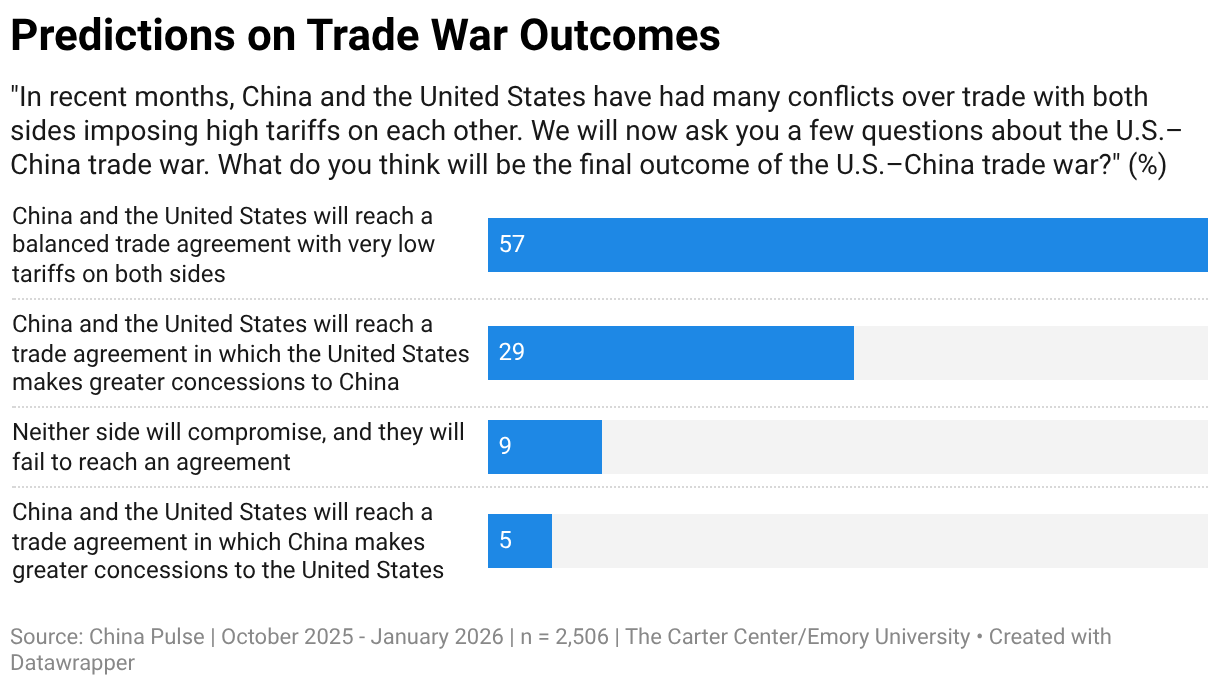
- A majority of the Chinese public believe that the United States and China will eventually reach a balanced trade agreement with low tariffs on both sides (57%). Although a minority, the next most predicted outcome is the United States will make great concessions to China (29%).
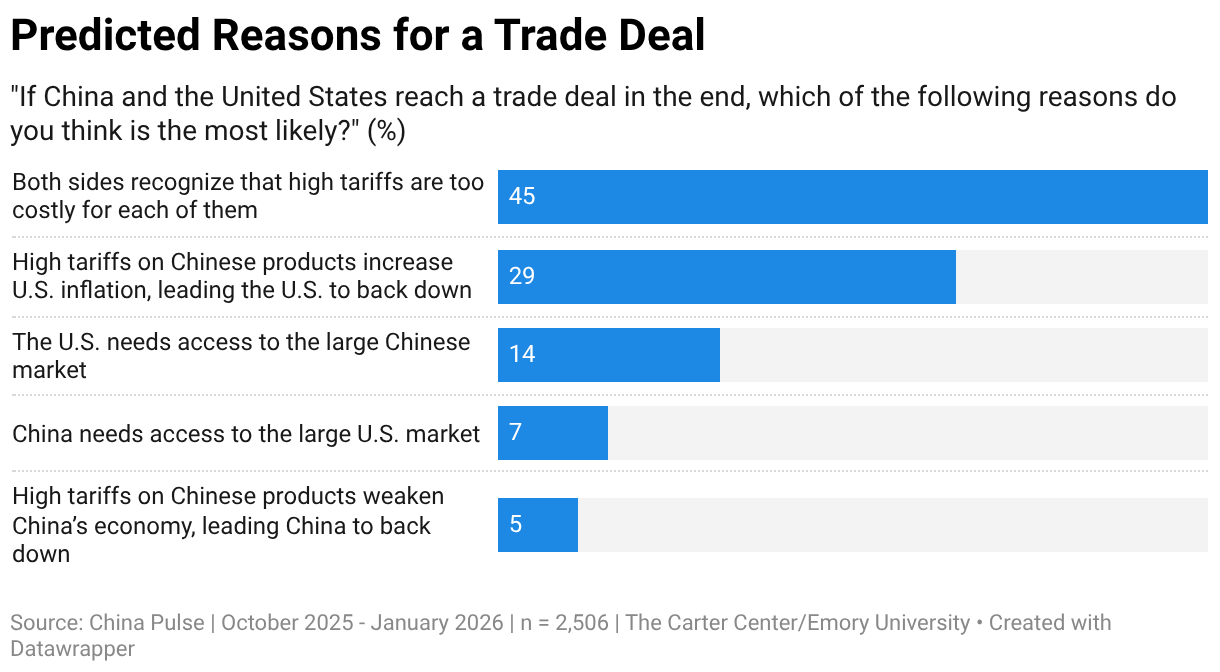
- A plurality of the Chinese public believes an agreement will be reached because the economic damage from tariffs is too costly for both sides (45%). A smaller portion believe tariff-induced inflation in the United States will compel Washington to back down (29%).
- Most Chinese expect their economy to grow despite continued trade conflict with the United States (49%), but the plurality expect this growth to be slow (37%).
- The Chinese public wants their government to retaliate if the United States initiates a trade war even if retaliation harms China’s economy (62%).
- Preferred methods of trade war retaliation include rare earth export controls (66%), tariffs of U.S. products (58%), limiting U.S. companies’ access to the Chinese market (52%), shifting exports away from the United States (52%), and banning U.S. agricultural products (51%).
- Rare earth restrictions are also the most preferred response to continued restrictions on chip exports to China (40%), above increased investment in China’s semiconductor industry (35%), bypassing restrictions through third countries (21%), and direct U.S.-China negotiations (4%).
The Chinese Public Are Ready to Deal but Not Back Down
Trade has been a particular point of contention between Washington and Beijing since the first Trump administration imposed sweeping tariffs on Chinese imports in 2018. In 2025, the trade war between both countries escalated again as President Trump imposed 150 percent tariffs on goods from China. Beijing responded with its own levies until trade talks were held in May, resulting in a 90-day pause on tariffs. Tensions arose later that month as Washington threatened to revoke visas for Chinese students studying at American universities in retaliation for claims that China was violating the new trade agreement and curbing rare earth exports. A new agreement was reached at a meeting in London in June. The remainder of the year saw reciprocal use of tariffs and disputes over export restrictions, particularly on advanced chips from the United States and rare earths from China, until another truce was reached in October when both presidents met in Busan, South Korea. At present, U.S. domestic questions about the legality of the Trump administration’s tariffs and the impact of the U.S.-Israeli war on Iran have led commentators to question what President Trump’s announced trip to China in March 2025 can achieve or if it will occur.
This survey finds that 73 percent of the Chinese public views the United States as a national security threat. Of that 73 percent, 80 percent agree U.S. influence on international trade and economics is a source of that threat (see full results here). These results are consistent with surveys from Tsinghua University’s Center for International Security and Strategy, which find that the Chinese public ranks economic and trade interests as the number one factor impacting U.S.-China relations. Despite this concern, this survey finds that a majority of the Chinese public expect an equitable resolution to U.S.-China trade conflict (57%). A substantial minority anticipate that the United States will ultimately make concessions to China in seeking a trade deal (29%) while a much smaller number foresee no compromise at all (9%). According to the Chinese public, the least likely outcome is that China will make great concessions to the United States (5%).
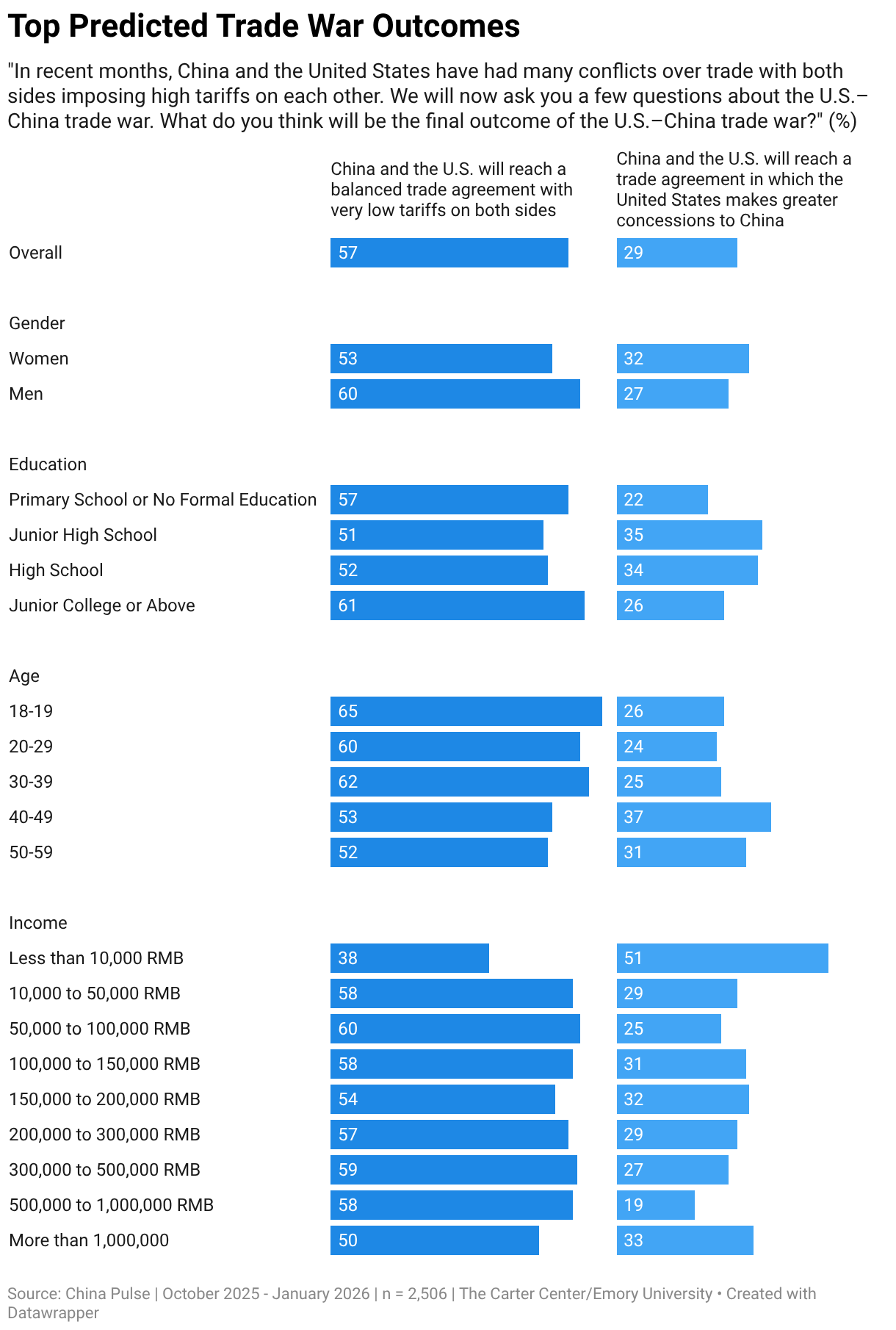
Chinese men anticipate a balance resolution to U.S.-China trade conflict at a higher rate than Chinese women (60% vs. 57%). Although a balanced agreement is the majority prediction across all age groups, Chinese under 40 years old are more likely to predict this outcome than those over 40 years old (62% vs. 53%). Chinese over 40 years old are more likely than those under 40 years old to predict the United States will make great concessions to China (34% vs. 25%). Those in the highest and lowest income levels (a small subset of the survey) are least likely to anticipate a balanced agreement.
According to the Chinese public, the most popular reason for an agreement is both sides will recognize that high tariffs are too costly (45%). The second most popular prediction is that high tariffs on Chinese goods with cause inflation in the United States to rise, leading the Washington to back down (29%). Less popular are the predictions that the United States will need access to the Chinese market (14%), that China will need access to the U.S. market (7%), and that high tariffs will weaken the Chinese economy, leading Beijing to back down (5%) (see Appendix for more detail).
The confidence this survey finds that the United States and China will either come to a balanced agreement or the United States will be compelled to make concessions to China complements the Chinese public’s predictions for China’s economy. Nearly half of the Chinese public believes China’s economy will continue to grow in the face of mutual high tariffs with the United States (49%). Of this half, however, most believe growth will be slow. It is also notable that 27 percent anticipate slow decline if mutual high tariffs continue.

Support for Retaliation in a Trade War
Most Chinese support their government retaliating against the United States in a trade war, even if it harms China’s economy (62%). Men support retaliation more than women (65% vs. 58%). Those with a high school education and above support retaliation more than those with less education (63% vs. 60%). Perhaps reflecting a higher likelihood for older respondents to believe the United States will ultimately make concessions to China, Chinese over 40 years old are more likely than those under 40 years old to support retaliation against the United States (63% vs. 57%).

This survey find that the retaliation the Chinese public supports most is restrictions on rare earths and solar panels (66%), followed by the imposition of tariffs on the United States (58%), limitation of U.S. companies’ access to China’s market (52%), diversification of China’s export markets away from the United States (52%), and bans on U.S. agricultural products like pork and soybeans (51%). There is little support for government subsidies to support industries harmed by U.S. tariffs (35%) or to restrict Americans living in China (25%) (see Appendix for more detail).

Similarly, the Chinese public most support the implementation of rare earth export restrictions in retaliation for chip export sanctions from the United States (40%). The Chinese public ranks further investment in Chinese manufacturing below retaliatory measures (35%). Bypassing restrictions through third countries (21%) and negotiating with the United States (4%) received the least support (see Appendix for more detail).

Conclusion
This survey demonstrates that the Chinese public is ready to reach an agreement with the United States to end nearly a decade of trade disputes. However, they anticipate that this agreement will be balanced and do not foresee Beijing making concession to Washington. Should the United States reignite a trade war, the Chinese public supports its government’s measures of retaliation, even at the cost of their own national economy. The Chinese public has learned from the trade disputes in 2025 and is prepared for their government to repeat what worked – rare earth export restrictions. In the case of responding to tariffs and chip export controls, they prefer rare earth restrictions over increased investment in China’s economy, perhaps signaling the frustration that has built up over the last decade of sour U.S.-China relations. These results are encouraging insofar as they demonstrate a willingness among the Chinese public to come to a new agreement with the United States. However, they also indicate that the risk of not coming to an agreement could be severe. The Chinese public seems willing to sacrifice to get what it wants out of the United States if necessary.
Methodology
This study employs a repeated cross-sectional design, conducted in collaboration with a China-based survey company maintaining a large respondent panel. We initiated the research with a pilot wave (N=1,428) in July and August 2025 to refine question wording and validate internal logic. The results were treated as preliminary validation for the main study.
The core findings derive from the first official wave, which surveyed 2,506 Chinese adults between October 27, 2025, and January 1, 2026. Utilizing quota sampling, the demographic profile matches China’s population on key variables, including age, gender, and geographic distribution across the North, East, Southwest, Northeast, South Central, and Northwest regions. The 50-question survey yielded a median completion time of 16.75 minutes.
About the Authors
Nick Zeller is a senior program associate for The Carter Center’s China Focus and editor of the English-language U.S.-China Perception Monitor website. Prior to joining the Carter Center, Nick was a Visiting Assistant Professor of World History in Kennesaw State University’s Department of History and Philosophy, Visiting Assistant Professor of Asian History in the University of South Carolina’s Department of History, and an NSEP Boren Fellow at Tsinghua University in Beijing. He received his Ph.D. in modern Chinese history from the University of Wisconsin-Madison.
Renard Sexton is a political scientist who studies conflict and development, particularly in Asia and Latin America. His research combines quantitative methods, fieldwork, and experiments, and has been published in top academic journals, policy forums and public outlets. From 2022 to 2023 he served as a senior advisor in the China/Taiwan unit at US Indo-Pacific Command through a Council on Foreign Relations (CFR) fellowship. He is currently Associate Professor of Political Science at Emory University, and the director of the Security and Conflict Lab.
Yawei Liu is the Senior Advisor on China at The Carter Center and an adjunct professor of political science at Emory University. An expert on U.S.-China relations and Chinese grassroots democracy, he is a member of the Council on Foreign Relations and the associate director of the China Research Center in Atlanta. He is regularly invited to speak about Chinese public opinion, and his previous engagements include the Center for Strategic and International Studies, the Brookings Institution, the Ukrainian National Academy of Sciences, and the Institute for China-America Studies.
About The Carter Center
Waging Peace. Fighting Disease. Building Hope.
A not-for-profit, nongovernmental organization, The Carter Center has helped to improve life for people in over 80 countries by resolving conflicts; advancing democracy, human rights, and economic opportunity; preventing diseases; and improving mental health care. The Carter Center was founded in 1982 by former U.S. President Jimmy Carter and former First Lady Rosalynn Carter, in partnership with Emory University, to advance peace and health worldwide.
About The Carter Center’s China Focus
The Carter Center is an independent, nonpartisan organization. Through its China Focus initiative, the Center seeks to improve the U.S.-China relationship through a thoughtful assessment of the international records of both countries. We convene leading Chinese and American policy professionals and academics, conduct pioneering research in Chinese public opinion, support next generation foreign policy experts, and publish research-backed opinion. Our goal is to contribute to lasting international peace between the world’s two largest powers, which is the foundation for solving the biggest problems facing humanity today.
About Emory University’s Department of Political Science
The intellectual mission of the Department of Political Science is twofold. First, we seek to engage in knowledge-building through rigorous theoretical and empirical research that enables us to address urgent contemporary political challenges related to democratic institutions and governance, identity and difference, inequality, and political violence. Second, we aim to train students who will become the next generation of scholars and practitioners through the skills we impart to them both in and outside of our classrooms. The rise of political polarization and populism in the United States and other countries make clear that democratic governance cannot be taken for granted. Global crises such as the COVID pandemic and climate change also demonstrate the need for solutions that are not only scientifically correct, but also politically feasible. More than ever, a greater understanding of the incentives and behavior shaping political life is necessary.
Appendix A: Top Predicted Reasons for a Trade Deal (All Demographics)

Appendix B: Top Preferred Responses to Continued Tariffs (All Demographics)

Appendix C: Preferred Responses to U.S. Chip Export Restrictions (All Demographics)