[Editor’s note: This is the translation of the commentary authored by KS Liu on October 30, 2026. The views expressed in the commentary are those of the author. They do not reflect the views of US-China Perception Monitor. Click HERE to access the original Chinese commentary.]
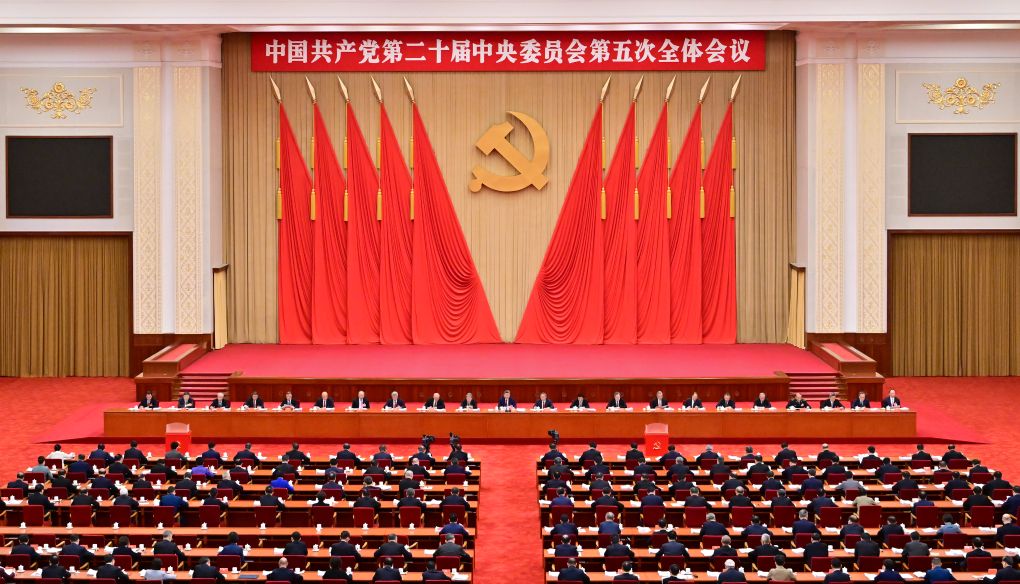
The Fifth Plenum of the 20th Central Committee of the Chinese Communist Party has concluded. By examining the official Xinhua communiqué alongside the documents issued after the previous two plenums, we can discern important changes in the CCP’s political direction over the past three years.
The Third Plenum, held in July 2024, was attended by 199 full Central Committee members and 165 alternate members. Its theme was “further comprehensively deepening reform,” with an emphasis on improving institutions and stimulating economic vitality. It adopted the Decision on Further Comprehensively Deepening Reform.
168 full members and 147 alternates attended the Fourth Plenum in October 2025,. The meeting focused on formulating the 15th Five-Year Plan, emphasizing economic development, technological innovation, and modernization, and adopted recommendations for the plan.
At the Fifth Plenum in October 2026, attendance fell to 162 full members and 117 alternates. Its central theme was comprehensively strengthening Party discipline, with an emphasis on Party building, discipline, and governing capacity. It adopted a decision on sustaining comprehensive and rigorous Party self-governance.
From the Third to the Fifth Plenum, the number of attending full Central Committee members fell by 37, or about 18.6 percent, while alternate-member attendance declined by 48, or roughly 29.1 percent. Combined attendance dropped from 364 to 279, a decrease of 85.
This decline deserves attention, but it would be incorrect to assume that all 85 were investigated or removed. Attendance can be affected by absence, changes in position, retirement, death, disciplinary action, and other factors.
From Reform and Development to Party Control
The Third Plenum emphasized using reform to address development problems. Its representative formulation was that economic structural reform should serve as the driving force for further liberating and developing the productive forces and enhancing social vitality.
The Fourth Plenum shifted toward achieving development objectives through planning. It reaffirmed economic development as the central task, high-quality development as the theme, reform and innovation as fundamental drivers, and comprehensive and rigorous Party self-governance as the political guarantee.
The Fifth Plenum moved further toward the Party’s internal governance. Long-term governing capacity, political and organizational discipline, supervision, and “self-revolution” became central themes.
This progression is significant. The emphasis moved from reform as the instrument of development, to planning as the framework for development, and ultimately to Party discipline and self-governance as safeguards of political control and governing capacity.
The Military as the Most Important Political Signal
Personnel changes in the military are arguably the most consequential political signal from the Fifth Plenum.
The communiqué confirmed disciplinary action against Zhang Youxia, Liu Zhenli, and other senior military officers, while Zhang Shengmin was elevated to the Politburo.
These developments have at least three implications.
First, military anti-corruption efforts are no longer confined to lower levels or particular procurement apparatus but have reached the senior command structure.
Second, the concentrated removal of senior officers may affect command stability, trust among military leaders, and continuity in military decision-making.
Third, Zhang Shengmin’s elevation to the Politburo suggests an enhanced position within the central power structure for senior officials responsible for military discipline and political supervision.
A Subtle but Important Change in Political Language
All three plenums reaffirmed “Xi Jinping Thought on Socialism with Chinese Characteristics for a New Era.” Yet another set of familiar political formulations changed noticeably.
The phrases referring to the “Two Establishes,” “Four Confidences,” “Four Consciousnesses,” and “Two Upholds” appeared explicitly in the Third and Fourth Plenum communiqués but were omitted from the Fifth.[1]
All three documents stressed the centralized and unified leadership of the Party Central Committee. The Fifth Plenum, however, gave unusual prominence to democratic centralism. Although the Third and Fourth Plenums also mentioned the concept, it was not a major theme.
This omission is especially notable because the Fifth Plenum dealt directly with strict Party governance, political discipline, organizational discipline, and the Party’s leadership system, subjects that would normally lend themselves to reiterating those established formulations. Instead, the communiqué emphasized democratic centralism, intra-Party democracy, and decision-making rules for leadership bodies.
The contrast is even more striking in the military sphere.
The Third Plenum’s 2024 Decision called for improving the institutional mechanisms for implementing the Central Military Commission chairman responsibility system and strengthening the political foundation of the armed forces. The important words were “institutional mechanisms”: the goal was not simply obedience to the CMC chairman but embedding that authority in organizational structures, decision-making procedures, and command mechanisms.
The Fourth Plenum stated directly that China must uphold the Party’s absolute leadership over the People’s Liberation Army and implement the CMC chairman responsibility system.
The Fifth Plenum communiqué, by contrast, did not directly mention the CMC chairman responsibility system. Instead, it declared democratic centralism to be the Party’s “fundamental organizational principle and leadership system” and called for fully developing intra-Party democracy while practicing correct centralization.
It also called for improving the quality of intra-Party democracy, strictly enforcing decision-making rules within leadership bodies, and regulating the exercise of power by the “number-one leader.”
Taken together, this represents a genuine shift in political language: from emphasizing the authority of the top military leader toward greater emphasis on collective organizational rules and procedures within the Party.
That does not by itself demonstrate a weakening of Xi Jinping’s authority. But it is a change worth watching.
Changes in the Central Military Commission Go Beyond Rhetoric
Changes involving formulations such as the “Two Establishes” and “Two Upholds” may primarily reflect shifts in political rhetoric. Changes in the composition of the Central Military Commission, however, represent tangible changes in the power structure.
Between the Third Plenum in 2024 and the Fifth Plenum in 2026, the CMC went from a relatively complete seven-member leadership body to one in which successive senior generals were removed, leaving only two publicly serving members. Nearly the entire professional military leadership at the commission’s highest level had departed.
When senior leaders with substantial military experience leave in rapid succession and a new leadership structure has not yet been fully established, the quality of decision-making, professional coordination, and continuity of policy implementation could be affected.
The CMC’s senior organizational structure has clearly undergone major change. How power is actually distributed within the new arrangement, however, requires further evidence.
The Anti-Corruption Paradox
All three plenums emphasized anti-corruption, but its place on the political agenda changed.
The Third Plenum situated rigorous Party self-governance within the broader framework of deepening reform. The Fourth treated it as the political guarantee for implementing the 15th Five-Year Plan. The Fifth went further, adopting a dedicated decision on comprehensive and rigorous Party self-governance and systematically addressing intra-Party supervision, cadre discipline, and anti-corruption mechanisms.
Two aspects of the Fifth Plenum communiqué are particularly important.
First, it acknowledged that the tests and dangers facing the Party are long-term, complex, and severe. In other words, the official assessment itself does not suggest that more than a decade of anti-corruption efforts has fundamentally eliminated the problem.
Second, the campaign continues to reach a remarkably broad range of senior officials. The Fifth Plenum confirmed the expulsion from the Party of 33 people and the removal of Li Yunze from his Party posts. Those disciplined came from the Party-state bureaucracy, finance, defense industries, and senior military ranks.
This raises an unavoidable question: If anti-corruption has achieved fundamental institutional success, why was it still necessary in 2026 for a Central Committee plenum to devote itself specifically to the continuation of strict Party governance?
There are two possible interpretations.
The official CCP interpretation is that the continued expansion of anti-corruption demonstrates the Party’s growing capacity for self-purification.
An alternative interpretation is that top-down disciplinary inspection and political rectification can punish large numbers of corrupt officials without necessarily eliminating the conditions that allow corruption to flourish when political power lacks effective external constraints.
The Fifth Plenum communiqué itself demonstrates that the anti-corruption task remains unfinished. It cannot, on its own, establish which institutional approach to controlling corruption is more effective.
Xi Jinping’s Achievement and His Institutional Dilemma
Since Xi Jinping came to power in 2012, the scale, duration, and seniority of officials targeted by anti-corruption investigations have been extraordinary. Those investigated or disciplined have ranged from Politburo Standing Committee members and CMC vice chairmen to provincial and ministerial officials, state-owned-enterprise executives, and grassroots cadres.
Xi can therefore be credited with at least two accomplishments.
First, the campaign broke through some of the informal protections that had made certain senior officials difficult to be investigated.
Second, sustained disciplinary inspections and supervisory investigations increased the real risk of punishment for corruption.
Measured by the number and seniority of officials investigated and the persistence of enforcement, anti-corruption has unquestionably been one of the defining political initiatives of Xi’s tenure and can reasonably be regarded as an achievement.
But there is a fundamental distinction between how many corrupt officials have been punished and how much corruption has actually been reduced.
A rising number of cases may indicate extensive corruption, more effective enforcement, or both. The number of officials punished therefore cannot by itself demonstrate fundamental success.
Official figures sharpen this problem. According to the commentary’s cited 2025 disciplinary-inspection data, 1.012 million cases were opened, 983,000 people received disciplinary sanctions, and cases were opened against 115 officials at the provincial or ministerial level or above. The 2026 Fifth Plenum subsequently confirmed the expulsion of 33 Central Committee members and alternate members, including numerous senior military officers.
But an even more consequential political question arises: Why were so many of the senior officials eventually disciplined promoted during Xi Jinping’s own tenure?
The Problem of Cadre Selection
The military illustrates the dilemma.
He Weidong entered the Central Military Commission in 2022 and became a vice chairman, while Miao Hua also held important military leadership positions during Xi’s tenure. Both were subsequently disciplined for serious violations.
That creates a difficult question. If the leadership system was capable of identifying and punishing these officials for corruption or disciplinary violations, why did the cadre selection, vetting, and supervision system fail to identify the problems before they reached the highest levels of leadership?
As the longtime general secretary and chairman of the Central Military Commission, Xi cannot avoid leadership responsibility for the effectiveness of the system through which senior officials are selected.
The deeper the anti-corruption campaign goes, and the more senior officials it exposes, the more questions arise about the effectiveness of the selection system itself. At a minimum, after more than a decade of anti-corruption efforts, serious disciplinary and legal violations at the highest levels of the CCP have not been fundamentally eliminated.
There is observable evidence of progress in making officials “dare not be corrupt.” There is far less convincing evidence of equivalent success in ensuring that officials “cannot be corrupt” or “do not want to be corrupt.”
Who Supervises the Supervisors?
Xi Jinping’s anti-corruption model relies primarily on centralized Party leadership, disciplinary and supervisory investigations, inspection campaigns, organizational punishment, and judicial accountability.
This top-down approach has obvious advantages. It can act quickly and concentrate political resources on investigating even very senior officials.
But it also raises a fundamental institutional question: Who supervises the supervisors?
If corruption is primarily detected, investigated, and punished by superior authorities, the effectiveness of the system depends heavily on the willingness, judgment, and personnel choices of those authorities.
Achieving a durable system in which officials “cannot be corrupt” therefore requires more than severe punishment. It requires sustainable constraints on the exercise of power, including greater transparency in public decision-making, effective management of conflicts of interest, more independent auditing and judicial supervision, and credible protection for whistleblowers.
Whether the current system can provide such constraints will have to be demonstrated through actual institutional change.
The Political Paradox of Xi’s Anti-Corruption Campaign
The paradox is more complicated than simply saying, “many corrupt officials have been caught, yet corruption persists.”
The greater the campaign’s achievements, the more they reveal about the severity of the corruption that existed. The longer the campaign continues, the more important it becomes to evaluate the effectiveness of the anti-corruption system itself. And the more senior officials promoted during Xi’s own tenure are subsequently disciplined, the harder it becomes to attribute the problem entirely to the political legacy of previous administrations.
After more than a decade in power, anti-corruption can therefore be viewed simultaneously as one of Xi Jinping’s most prominent political achievements and potentially one of his most consequential institutional failures.
He has presided over an enormous campaign that punished large numbers of officials for disciplinary and legal violations. But that campaign has yet to demonstrate that China has established a durable system that makes officials not only afraid to be corrupt, but unable and unwilling to be corrupt.
The fact that a number of severely disciplined senior officials were themselves promoted during Xi’s tenure raises questions extending beyond individual misconduct. It points toward the functioning of elite personnel selection, supervision of political power, and institutional governance at the highest level.
This is the central paradox of Xi Jinping’s anti-corruption campaign: the more power is concentrated at the top, the more difficult it becomes for the top leadership to avoid responsibility for institutional failure.
The Fifth Plenum does not provide sufficient evidence to conclude that Xi Jinping’s paramount authority has been fundamentally weakened. It does, however, provide substantial evidence that cadre selection, military governance, and anti-corruption supervision under his leadership continue to face serious institutional challenges.
The ultimate issue may therefore be whether China can build institutions that no longer depend on the country’s paramount leader repeatedly launching anti-corruption campaigns to keep the political system in check.
- The Chinese for these terms are “两个确立、四个自信、四个意识、两个维护”. 两个确立 — the Two Establishes: 确立习近平同志党中央的核心、全党的核心地位;确立习近平新时代中国特色社会主义思想的指导地位 (establish Xi Jinping’s core position on the Party Central Committee and in the Party as a whole; establish the guiding role of Xi Jinping Thought on Socialism with Chinese Characteristics for a New Era.); 四个自信 — Four Confidences: 道路自信、理论自信、制度自信、文化自信(confidence in the path, theory, system, and culture (of socialism with Chinese characteristics); 四个意识 — Four Consciousness: 政治意识、大局意识、核心意识、看齐意识(political consciousness, consciousness of the overall situation, consciousness of the core, and consciousness of keeping in line); 两个维护 — the Two Upholds: 坚决维护习近平总书记党中央的核心、全党的核心地位;坚决维护党中央权威和集中统一领导 (resolutely uphold Xi Jinping’s core position on the Party Central Committee and in the Party as a whole; resolutely uphold the Central Committee’s authority and its centralized, unified leadership). ↑