
.jpg)
The United States has long approached its relationship with Africa through the lens of aid, including humanitarian assistance, development programs, and soft-power initiatives often channeled through USAID and multilateral institutions. This model positioned America as a benevolent donor, countering rivals such as the Soviet Union during the Cold War and, more recently, attempting to blunt China’s influence through conditional support tied to governance reforms and democratic values. But that era has ended.
Under Trump 2.0, the United States has taken an unconventional step away from aid as the primary tool for countering China in Africa. Instead, it is deploying capital through private sector-led investments, development finance, and targeted commercial partnerships as the front line instrument in great-power competition. This paradigm shift marks a new phase in Africa’s geopolitical centrality, where influence is no longer granted by generosity, but earned through practicable economic partnerships for shared prosperity.
This pivot is starkly visible in policy and data. Traditional aid channels, particularly through USAID, have faced severe reductions. In early 2025, the Trump administration imposed a near-total freeze on foreign assistance, leading to the effective dismantling of USAID, the cancellation of over 80 percent of its programs, and the rescission of billions of dollars in previously appropriated funds. These cuts, part of a broader re-evaluation of foreign aid, have slashed humanitarian, health, and development support in Africa. This has created ‘short term’ gaps in areas such as nutrition, education, and crisis response, where China has not fully filled the void. Reports from organizations including Oxfam and the Center for Global Development estimate that, if sustained, such reductions could contribute to hundreds of thousands of preventable deaths annually, eroding long-term U.S. goodwill.
For nearly two decades, China dominated Africa’s external financing landscape, funding roads, ports, railways, and power plants at a scale few could rival. That era is now changing. Beijing has shifted from being Africa’s largest bilateral lender to prioritizing debt recovery, risk control, and financial consolidation. Recent reports show that Chinese lending to Africa dropped nearly 50 percent in 2024 to about $2.1 billion, a continuation of a longer decline from peaks around the mid-2010s. As domestic economic pressures mount in China, easy capital abroad has become scarcer. The result is not withdrawal, but recalibration, marked by a shift from large-scale infrastructure projects to smaller, more targeted investments.
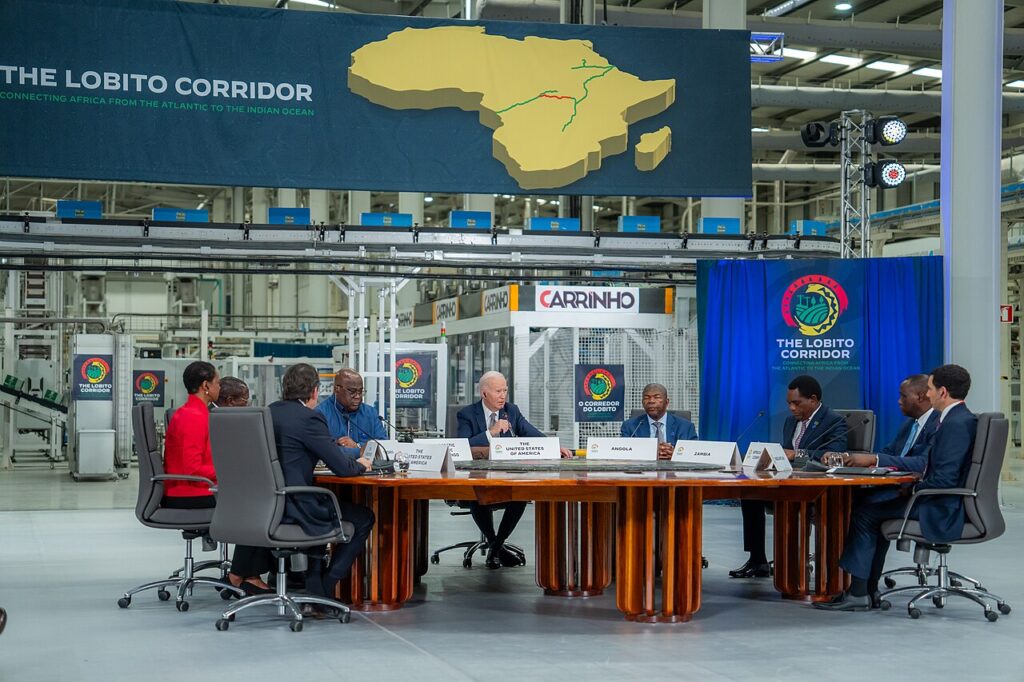
Washington has read this moment carefully. Rather than filling the gap with traditional aid or state-backed loans, the United States is advancing an investment-first model that emphasizes bankable infrastructure, private-sector leadership, and co-financing with African governments. Initiatives such as the Partnership for Global Infrastructure and Investment, alongside US-backed financing through the Development Finance Corporation, have prioritized transport corridors, energy projects, and digital infrastructure. High-profile examples include investments linked to the Lobito Corridor connecting Angola, the Democratic Republic of Congo, and Zambia. U.S. ambassadors are increasingly assessed not on political alignment, but on their ability to facilitate commercial deals. In this framing, Africa is no longer treated as a development project, but as a strategic economic partner, a major breakthrough for a continent that has been spoon-fed for decades.
This approach reflects a broader shift toward geoeconomic statecraft. The United States is aligning its Africa engagement with continental priorities such as regional trade integration, transport corridors, digital infrastructure, and energy systems, areas where returns are long-term but transformative. By anchoring projects to commercial viability rather than political symbolism, Washington is betting that sustainability, rather than speed, will determine influence.
There is also a monetary dimension that is often overlooked. A softer U.S. dollar, designed to boost American exports, has the side effect of easing Africa’s dollar-denominated debt burden, since exchange rates and currency valuation directly affect debt servicing costs and fiscal sustainability. Reduced debt servicing costs create fiscal space for African governments to co-invest in infrastructure and industrial projects. This alignment of macroeconomic incentives with strategic objectives is deliberate rather than accidental. China’s engagement, by contrast, is becoming increasingly asset- and resource-focused, especially in securing minerals such as copper and cobalt that are critical for electric vehicles and batteries. Additionally, some African governments, like Kenya, are exploring yuan-denominated debt and negotiations to convert existing dollar obligations into yuan to manage currency-related debt pressures.
For Africa, this moment carries both opportunity and risk. The days of abundant, unconditional external finance are fading. In their place is a more demanding environment where project quality, regulatory credibility, and regional coordination matter more than diplomatic rhetoric. Countries that can aggregate markets, standardize rules, and prepare investable projects will gain leverage. Those that cannot may find themselves squeezed by both sides. The deeper shift, however, is psychological. Africa is no longer being courted; it is being priced. Access to markets, minerals, and legitimacy now comes with clear economic expectations. This places greater responsibility on African governments but also grants them greater agency.
U.S.-China competition in Africa is not disappearing. It is maturing, and over time the narrative of “debt-trap diplomacy” is likely to erode as Africa’s external partnerships become more transactional and disciplined. In this new phase, power will not belong to whoever spends the most, but to whoever helps Africa build economies that endure beyond geopolitics.