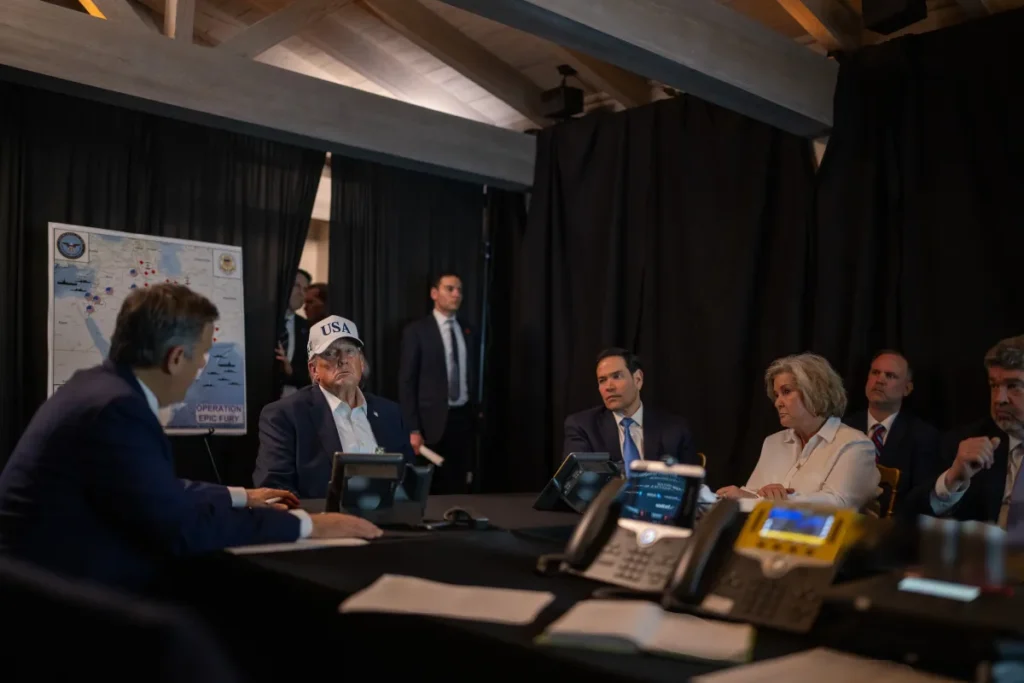
The military action launched by U.S. President Donald Trump against Iran was, at the tactical level, a surprise operation executed with careful preparation. From intelligence coordination to military deployment, the strike demonstrated a high degree of synchronization. Judging by the short-term impact of a “decapitation strike,” the operation achieved phased success: Iran’s top leadership was dealt a heavy blow, and its decision-making core was nearly wiped out. In terms of military execution alone, it was a highly efficient action.
Iran’s current regime has long maintained theocratic authoritarian rule, enforcing domestic repression while seeking to expand its regional influence abroad. Its economic governance and diplomatic posture have faced persistent challenges, and it has grown increasingly isolated internationally. From a moral standpoint, weakening or even overthrowing such a regime may not be difficult to justify in the court of public opinion.
However, the central issue is not whether the operation achieved temporary “success,” but whether it is legitimate and what consequences will follow.
First, the military action violates international law. Without authorization from the United Nations, launching a large-scale military strike and conducting a “decapitation” operation against a sovereign state is difficult to justify within the framework of international law. Regardless of motive, using force to alter another country’s political structure fundamentally infringes upon the principles of sovereignty and territorial integrity. Imposing the will of one state over the other through force reflects the logic of power politics and undermines the existing international order.
Second, the operation also raises questions under U.S. domestic law. From a constitutional perspective, a military action of such scale should, in principle, receive authorization from Congress. Historically, major overseas military operations, including the Iraq War, have gone through congressional procedures. Even if the first phase of the Iran operation produced notable military results, it does not erase concerns about procedural legitimacy.
More troubling is the ambiguity and contradiction in strategic objectives. On the one hand, Trump has called on forces within Iran to push for regime change, implying an intention of “state-building.” On the other hand, U.S. Defense Secretary Pete Hegseth on a speech delivered on March 2 emphasized that the objective was limited to destroying Iran’s missile, naval, and nuclear capabilities—not to promote democratic transformation.
Is the aim to destroy military capabilities, or to bring about regime change? If the goal is merely to degrade Iran’s military strength, that is destruction without construction—it dismantles but does not build, and therefore fails to resolve long-term problems. If the objective is democratic transformation, it contradicts Trump’s campaign pledge not to use military means to promote democracy abroad and risks drawing the United States into a prolonged entanglement. The wavering of strategic objectives will directly affect the feasibility and cost of subsequent actions.
Trump’s military action is a major gamble. Once Pandora’s box is opened, how events unfold will no longer be fully within his control. Decapitation strikes do not necessarily lead to regime collapse. The Iranian regime is a theocratic regime that possesses organizational resilience, mobilization capacity, and the ability to harness nationalist sentiment under external pressure. Even if opposition forces exist domestically, external military attacks may trigger a “rally-around-the-flag” effect. Although Iran’s retaliatory moves in the region currently appear disorganized, it remains uncertain whether it can quickly regroup and mount a more coordinated response. Iran’s leadership was struck due to American surprise; if the regime manages to reorganize and survive, its retaliation is unlikely to cease simply because the United States ends its military operations.
Domestic politics in the United States constitutes another crucial variable. Trump originally won support under the banner of “America First,” pledging that the United States would no longer serve as the world’s policeman. Consecutive overseas military actions are bound to raise doubts among his supporters. Voices within both the Democratic and Republican parties have called for strengthening congressional oversight of war powers. Moreover, the justification for the Iran strike remains controversial. At the time, U.S.–Iran negotiations were still underway, and Iran had not posed an imminent direct threat. Launching a surprise attack under such circumstances makes it more difficult to defend the action’s legitimacy. Current U.S. polling shows that fewer Americans support the military action than oppose it, and many lack confidence in Trump’s handling of the situation. If the war drags on and U.S. casualties rise, Trump will face an increasingly difficult political dilemma.
The economic consequences should not be overlooked. The shadow of war has already caused sharp fluctuations in financial markets, with clear upward pressure on oil prices. If the conflict persists and disrupts energy supply chains, inflation risks will intensify. For a U.S. administration in an election cycle, economic performance is directly tied to political fate. Historically, the president’s party tends to lose seats in midterm elections. If compounded by the economic pressures resulting from the Iran operation, the political cost for the Republican Party under Trump’s leadership could be even higher.
As for the impact on China, interpretations differ. Some believe the action is intended as a strategic signal to Beijing, given China’s energy and trade ties with Iran. The reality, however, is more complex. China has exercised considerable restraint in its public statements and has shown no indication of direct military support. Some commentators group Iran, China, Russia, and North Korea into a so-called “anti-American axis,” but this characterization is flawed; in practice, there is little evidence of meaningful coordination among these states. China needs Iranian energy, yet it must also weigh regional stability and global market risks. Its likely approach will be one of cautious balancing. For example, a disruption of the Strait of Hormuz would affect global energy supplies and would undoubtedly hurt China, which imports significant amounts of Iranian oil. However, China has accelerated its development of renewable energy in recent years, and its long-term dependence on oil is expected to gradually decline. It could also partially offset supply disruptions by increasing oil imports from Russia. Thus, while U.S. military action against Iran may create energy-related pressures for China, these challenges are manageable.
In the final analysis, although the first phase of the U.S. strike on Iran may have achieved “success” at the military level, war is never a single-dimensional contest. Legal legitimacy, clarity of strategic objectives, domestic political support, economic resilience, and international reactions will ultimately determine its trajectory.
Hubris and unconstrained power often amplify a leader’s will, but it also tests the capacity of institutional checks and balances. Trump’s military actions against Iran, as well as previous actions against Venezuela, do not align with the “America First” slogan he repeatedly emphasized during his campaign or with the expectations of his MAGA base. At a time when both power and ambition appear to be expanding, whether the U.S. constitutional system can effectively constrain executive authority remains a question the world is watching closely.
Suisheng Zhao is a professor at the Josef Korbel School of Global and Public Affairs, University of Denver, where he also serves as the Executive Director of the Center for China-US Cooperation. He is the founding editor of the English-language Journal of Contemporary China.