
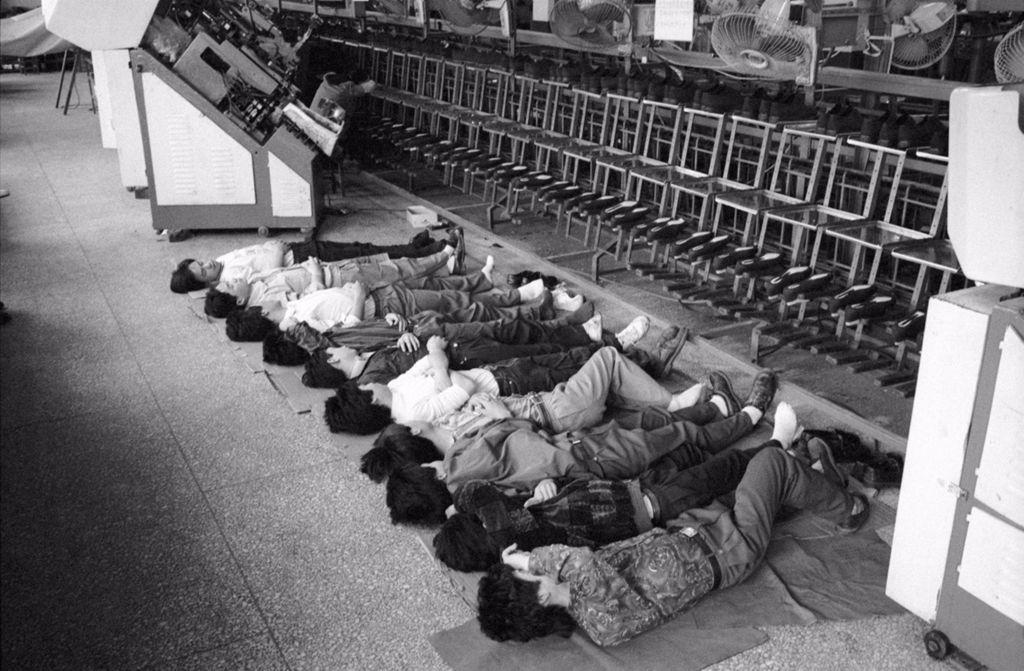
China’s trade unions are higher performing than most in the world. Unions have secured better wages, conditions, and benefits for workers, particularly in the logistics sector and increasingly for migrant workers. These benefits stem from directives by the Communist Party and are expanding in scope, making it difficult for workers to be dismissed unfairly, even in the age of AI. To understand the success of trade unions in China, the Monitor spoke with Immanuel Ness.
Immanuel Ness is a professor of political science at Brooklyn College, City University of New York. His research and published scholarly work focuses on the political economy of comparative labor movements, workers’ organizations, imperialism and anti-imperialism, socialism, and migration. He is editor of Journal of Labor and Society and Visiting Distinguished Professor, Department of Sociology, University of Johannesburg. His latest book, Dialectics of Chinese Labor: Trade Unions Under Market Socialism, was published in May 2026 and is available Open Access.
Emma Brignall: What inspired you to write Dialectics of Chinese Labor?
Immanuel Ness: The main reason I wrote the book was to correct the record regarding what is happening in China and to move beyond what I see as propaganda-driven narratives. I think it is important to meet people, have conversations with them, and engage in respectful dialogue. That was the approach I took throughout the research process, and I was able to open certain doors by doing that.
I found that people want to be supported and learn about new things. Chinese people have positive feelings toward Americans, which is something that most people in the United States don’t realize. That was one of the most important things I learned over the years.
EB: You write about the progress being made by the All-China Federation of Trade Unions (ACFTU) and its success despite trade unions declining across the globe. Can you walk me through some of the main arguments about how the ACFTU is improving workers’ lives?
IN: First of all, the ACFTU is both unique and not unique. It is unique because it is one of the few trade unions that is directly controlled by the Party—in this case, the Communist Party of China. In that regard, it resembles labor systems in countries such as Cuba and Vietnam, where trade unions are controlled by the political party in power.
At the same time, this arrangement is not entirely unusual. Around the world, many political parties maintain close alliances with trade unions, almost a dictate. The policies pursued by the party in power are frequently advanced through the affiliated union.
For many Americans, it can be difficult to understand how a country with a unified trade union structure can still contain democratic elements. During my research, I found many examples of democratic practices, particularly at the local level. There were examples of direct voting and leadership selection processes.
EB: Many Western scholars say that China is now a very capitalist state, yet you describe China as a transitional socialist state. How do trade unions fit within China’s socialist project, and where do you think the country is on that journey?
IN: China, as the People’s Republic of China, considers itself a socialist country led by a communist party. Most communist parties that come to power seek to build socialism. In my view, communism is somewhat a utopian concept. I think many people in China would agree that it represents a long-term ideal rather than an immediate reality. Chinese policymakers tend to be pragmatic. They focus on what is possible rather than on pursuing goals they consider unattainable.
In the Chinese context, as a socialist state, the state apparatus controls the state-owned enterprises but not the private sector. It exercises significant oversight over the private sector firms. That does not mean all workers are employed by the state; far from it. That is why I describe China as having a market economy. At the same time, I use the term “socialist” because I think it is important to take the country’s own institutions and goals seriously. Rather than engaging in diatribes, I would like to see what is going on and evaluate for myself.
Many commentators use the term “state capitalism” to describe China. The term is very demeaning for those who consider themselves to be socialists. Historically, many socialists have viewed “state capitalism” as capitalism. At the same time, there are different varieties of socialism, including forms of state socialism.
If you look at the work of many political economists, they would probably place China somewhere along a spectrum measuring the degree to which the state controls the economy. Most would agree that the Chinese state controls the economy more than almost any other country.
Over the last fifty years, particularly since the reform and opening period began, China has sought to improve living conditions. Achieving that required allowing market forces to play a role. It happened in the Soviet Union too. In 1921 Lenin introduced the New Economic Policy in the Soviet Union because the country was in severe economic disarray. His argument was that the economy needed to open up to provide for the people before establishing socialism or communism.
I view communism as a utopian idea. I think socialism is very hard to achieve. That is where I situate both the People’s Republic of China and the ACFTU. The Communist Party and many of China’s institutions are attempting to establish a socialist state. There are many elements of socialism and capitalism in the country. But to use the term “state capitalism” is intended to be demeaning and not the best diplomatic practice.
EB: Thinking about comparisons between American institutions and Chinese ones, what do Western scholars often get wrong about China’s unions? Why do you think the ACFTU has remained more successful than labor institutions in many Western countries?
IN: Chapter 3 of the book examines the failure of trade unions across the world. This is not simply a Western phenomenon but is growing in the Global South. In China, trade unions have been thriving. Some critics argue that this is because workers are forced to join unions. This is not true.
We currently live in an era often described as neoliberalism, where finance and capital control the economy. That has undermined trade unions in the United States and elsewhere. In the United States, a country of 330 million people, there is 5% union density in the private sector, which is the main segment of the economy. In China, it’s around 60-70%. The reason is because workers are not forced to become members of the union even if they are in a union shop. To me, that reflects a democratic principle. In fact, many conservatives in the United States would support that.
The reason unions have thrived in China is because the union has shown itself to be effective in defending working-class interests. There has been a degree of de-industrialization taking place in China. You have what is referred to as a “reserve army of labor”—unemployed people who are displaced from manufacturing or migrant workers in search of work. Consequently, large numbers of unemployed people now work as low-wage laborers in the digital economy: in logistics, transportation, food delivery, and platform-based employment.
In China, many workers do not view those jobs as long-term careers. The work is demanding. Workers are often under pressure to deliver goods quickly and can be reprimanded if they don’t.
What I found interesting is the role that the party and the ACFTU have played in addressing those conditions and helping implement labor-related policies advanced by the government. The ACFTU’s charge is to improve the conditions of workers. That is their only charge.
A useful example is the food delivery sector. In the United States, workers employed through platforms such as Uber Eats, DoorDash, and similar platforms lack employment protections and benefits. China has a number of major delivery companies, including JD.com, Meituan, and Ele.me. These companies have increasingly faced pressure to unionize workers and improve protections.
JD.com, for example, introduced a plan for all their new drivers to become members of the union and gain access to broad employment benefits. They gain access to systems that can support a longer-term career path, even if many ultimately want to move into something more lucrative. In turn, the other delivery firms follow suit and recognize workers as employees. Of course, some may fall between the cracks, but there is a drastic difference in trade union rights in the platform economy between China and the rest of the world.
In China, these workers have a wage standard—not a wage minimum—they receive healthcare benefits, automatic unionization if they want to be unionized, and social insurance similar to our social security. Depending on the employer, workers may also receive paid maternal and paternal leave. Workers who choose not to join a union can still benefit from many of the protections secured through collective representation.
That is an important difference. In the United States, there is a lot of literature being generated about the concept of “technofeudalism,” which is the idea that people are no longer employed by a company; they are just serving a company in some way and are not in the traditional employer-employee relationship. A book came out called Technofeudalism by Yanis Varoufakis. He came up with this terminology because people are not working for a company; they are working for themselves in that they have to rush to get as many deliveries through as possible. Multibillion dollar corporations in effect extract rent from the workers, who are like serfs in the fields of feudal lords. I reject this notion because firms are seeking to evade their responsibility to pay workers fair wages.
This is not to say that this phenomenon does not happen in China. But in the United States, logistics corporations do not provide health benefits for logistics workers. Uber has lobbied against it. A referendum which became law was passed in California in 2020 that bans workers in these industries from becoming employed by the company. If you’re doing all this work for Uber, you are not employed by Uber; they are just using you. That difference is significant. To have an employment contract with your employer, say Meituan, the company has to abide by the terms set by the trade union and the employer.
This is one reason I describe the system as a form of market socialism. China certainly has market mechanisms, but workers are incorporated into structures that provide protections and rights. While strikes do occur, there is a different culture around them, not one that seeks major disruptions as a public spectacle or a sign of force. China tends to favor legal mechanisms, such as going to labor courts to resolve the case.
I can compare that to my own experience as a union organizer. Years ago, when I worked with the American Federation of Musicians’ union, labor disputes in the United States often took years to resolve. A worker could be fired, file a claim against the employer, and spend four or five years waiting for a decision. By the time the case was resolved, the individual had often moved on to another job. There is a lot of mediation about which side is right and which is wrong. This practice has become the norm in labor-management relations in the United States.
In China, labor courts have proliferated and have typically found that the worker is almost always correct in their grievance against employers. By a rate of 90-95% of cases, workers win their cases against private employers. That does not mean workers are always right. Workers can violate workplace rules or commit an offense like stealing on the job. In the United States, they fire people for just about anything. I recently read about thousands of layoffs at Microsoft’s gaming division. Those workers simply lost their jobs. You cannot do that in China. There would have to be some process to restore the company so the workers could keep their jobs. There are exceptions, of course. No system is perfect, and there are examples that do not fit the broader pattern. But generally speaking, there is a stronger effort in China to have the unions and the workers make decisions about their workplace.
EB: It sounds as though this project required extensive fieldwork. Could you talk about your research process?
IN: Yes, it involved a substantial amount of field research. I traveled to China five separate times. I visited a variety of locations, met people from different backgrounds, and conducted as many interviews as possible. I was also struck by how Chinese workers relate to their work. In many cases, their attitudes differed significantly from what I am accustomed to seeing in the United States. The industrial worker has largely disappeared in the United States. In China, the industrial workforce is still very large. What I repeatedly observed was a strong sense of pride among workers in the products they create: it’s their work. They may be working in a factory and on the side have a shop designing lighting fixtures for those whose vision has deteriorated. I found many people taking interest in the work they do and making sure it’s done well.
EB: A large concern for China’s labor environment is the conditions faced by migrant workers to cities who do not have the same rights as local workers. How is the ACFTU benefiting them?
IN: That issue is discussed in Chapters 4 and 5 of the book, which focus on migration, floating labor, and urbanization. There is no question that China’s economic reforms led to a rapid movement of people to urban areas and a decline of conditions in rural areas.
Prior to the reform era, in Mao’s era, there was a level of prosperity in rural areas and people could survive in the countryside. In 1978, roughly 95 percent of the population lived in the countryside. Today, approximately 65 to 70 percent of the population is urbanized.
Some rural communities undoubtedly suffered during the transition. However, I would argue that the Chinese state has increasingly sought to address those challenges and improve living conditions. I’ve gone to rural areas and seen that displaced and unemployed workers have been able to go back to their place of origin as a safety net.
It’s unfathomable that close to one billion people have moved from rural areas to urban areas. China receives criticism for restrictions associated with residence permits, schooling access, and eligibility for public services. Those are all true. But those systems make it possible for the country to absorb populations. If you have nearly a billion people coming to cities without any services that would present problems.
That does not mean there are no problems. General Secretary Xi Jinping in the last five-year plan discussed the migrant population, which they are highly cognizant of. In the plan, he said the country needs to increase its capacity to serve these populations moving to urban areas. He said he believed that would continue to grow. Even larger numbers migrated to cities in the last few years than they expected, so now they have to recalculate what is necessary to serve that population without displacing those already there. There is a strong propensity for people to move to urban areas because wages tend to be higher, while rural communities often offer a more subsistence-oriented way of life. Also, it takes time to build schools, hospitals, and other infrastructure so that migrants can move to the cities with their families. This takes time, but China has integrated rural populations rapidly.
One of the themes running throughout my book is that there are no utopias. The United States has implemented countless programs throughout its history, and none have achieved absolute success. If you are able to incorporate and absorb most of the people who want to move to urban areas, that is a significant achievement. There are also highly skilled workers moving between provinces who have it easier, and less-skilled workers moving within a province.
Of course, workers can be exploited there, just as workers can be exploited anywhere else. But in China, most workers have a trade union to support them, unlike most of the rest of the world. The important question is how you stop exploitation from happening. Employers everywhere are not likely to treat their workers well if they can make more money by cutting costs, such as lunch. In China, companies have to pay for lunch. If you cut lunch out in China, you would probably have mass demonstrations across the country.
EB: You touched on this earlier, but could you discuss the relationship between the ACFTU and the Communist Party in more detail? Where are they mutually beneficial and where are they at odds?
IN: I want to be very clear that I do not try to hold anything back in this book. There is absolutely a direct connection between the Communist Party and the ACFTU trade union federation. In fact, the Party leads the union, not the other way around.
Over the past 80 years, Chinese leaders have faced repeated crises. The state has continually had to resolve these problems, whether successfully or unsuccessfully.
In that sense, the relationship between the party and the union reflects a broader strategy of economic and social development. Similar relationships can be found in Cuba and other socialist countries, although there are very few such examples today. I personally believe that a party alliance with the union can be effective.
The United States has a very different system. There is almost no relationship between the party and the union. It would probably be better if the Democratic Party had closer relations with its unions than it does today. But unions are interest groups and lobbyists trying to get a bigger share of the pie, such as teachers’ unions, healthcare unions, auto workers, steelworkers, and many others. That is lobbying, but in China, there is a decree by the Party that workers “in new forms of employment” —logistics, etc.—must be organized. I’ve seen many instances of success, although success does not take place overnight. The union has its own voice and there are people with differences of opinion within the union. In the public sector, the leading heights of the economy in China, all workers are unionized and paid higher wages. State-owned enterprises are more likely to pay higher and treat workers better because workers mobilize themselves and stay there for longer.
This differs significantly from the gig economy, where workers often view jobs as temporary. When I was eighteen years old, for example, I drove a taxi. I never intended to make that job my long-term career. Today, many young workers in China’s platform economy think similarly.
EB: Is China’s model of unionization one that you see being taken up by other countries? Does it present a challenge to the global capitalist system and Western hegemony?
IN: To understand China’s model of unions, you first have to understand China’s political system. China’s model of unionization is tied directly to the country’s broader political structure, which is based on the leadership of the Communist Party. There can be no other party. It’s a different system from what we have here, and I think we should respect it for what it is. We recognize a different kind of unionization here, although I increasingly recognize no unionization. Most voters in the U.S. are independents or nonaffiliated because political parties are unable to keep their members.
People often dismiss Chinese media outlets such as the Global Times or Xinhua as nothing more than state propaganda. They are and they aren’t. I read them with a grain of salt, considering whether the claims are supported, just as with the New York Times, which is often the mouthpiece of the government. Journalists develop sources with people in power, and report what they say.
One thing I have noticed as an instructor is a significant shift in attitudes toward China over the past decade. China is a country of people with aspirations, just like this country. Around 2015, public discourse became noticeably more antagonistic toward China. Information that students brought into the classroom was often not only inaccurate but also framed in highly confrontational terms. For example, one student asserted that women in China are required to change their names after marriage. That is not true. In fact, Chinese and East Asian women do not adopt their spouses’ surnames in the way that has been common in Western countries. These kinds of misconceptions illustrate why careful research and direct engagement are so important.
EB: Looking ahead, how do you expect the ACFTU to continue developing? What might that mean for socialism in China? And with the rise of artificial intelligence and technology-driven layoffs, is there a plan for addressing those challenges?
IN: Based on my discussions and research, the Chinese government would like to see workers enter more skilled forms of employment. They see new technology as a benefit rather than a threat to workers, and the workers and the trade union do as well. The expectation is that workers will receive training and a higher wage.
Interestingly, the issue that many people I spoke with viewed as a more serious threat was climate change. China has done remarkable work over the past two decades in decreasing pollution. Automobile companies in China produce electric cars for much of the world, which are much cleaner for the environment. In my discussions with people, they saw technological change as a positive development that they should embrace rather than fend off. There is a sense of competition with the U.S. because they do not want to be stomped on; they want to be treated equally and with respect, just as the U.S. does.
China has a history of never intervening in the internal affairs of other countries, even when some people would say they should have. In 1960, when Lumumba was assassinated, there was another person by the name of Mulele who was pro-China and he was assassinated too. The PRC recognized the government of Zaïre, which became the DRC. Some would say, “That is terrible. Why would they recognize an authoritarian state?” Not interfering in internal affairs is a very good policy on the whole. People like to have autonomy and run their own governments and China respects that, even if it also supports a transition to socialism, democracy, and equality.
The Chinese government believes in “win-win” cooperation, and I think there is value in that idea. The economic relationship that developed between the United States and China over the past four decades contributed significantly to China’s transformation. Now, however, we’re in a very bad place. There is too much animosity, and I don’t think the Trump administration has a coherent policy toward China at all.
Meanwhile, much of the literature about China across the spectrum from right to left in the U.S and globally, advocates for a big workers’ movement that will overthrow the state. Leonard Woodcock was the first ambassador to China, put into power under President Carter, and he would never have said that. What I think is controversial about this book is that I am just looking at what I see, with a certain perspective, of course, to see how various policies are enacted toward labor and how trade union struggles end up.
One example that influenced my thinking was a conversation I had years ago with the labor economist Richard Freeman of Harvard University and the National Bureau of Economic Research. More than a decade ago, he spoke about China as a place where union organizing was taking place. At the time, I was intrigued, but only in the past five years have I studied the labor system in China. We all need to learn a lot, and so I decided to embark on this project because I believe in a harmonious society and world, and I believe Chinese people and their government seek that. I also believe most Americans who benefit from the surfeit in consumer goods would like to see harmony between the U.S. government and China.