-20260514.jpg)
On February 21, 1972, at the welcoming banquet during his visit to China, President Richard Nixon quoted Mao Zedong’s line, “Ten thousand years is too long; seize the day,” and urged the Chinese and American people to rise to the heights of greatness.[1] That visit, the great ice breaking moment in U.S.-China relations, showed how two powers with deep mutual distrust, opposing political systems, and severe domestic constraints could acknowledge their differences while reorganizing hostility into a manageable mixture of cooperation and competition.
The diplomatic experience embodied in Nixon’s visit, what might be called the “spirit of 1972,” still offers guidance for managing U.S.-China relations today. But it should not be treated as a condition that already exists, or as a precedent that any American president can easily reproduce. Nixon and Donald Trump share certain structural circumstances: each confronted strategic pressure, domestic fatigue, and questions about the costs of American global leadership. Yet their views of politics, institutions, and international order differ profoundly. The spirit of 1972 flourished under Nixon because personal diplomacy was disciplined by strategic judgment, secrecy, and a willingness to be constrained by the requirements of a larger settlement. Under Trump, that spirit would have to be chosen and maintained. The point is therefore not that Trump is Nixon reborn. It is that if Trump and his administration were to embrace the discipline of 1972, the result would benefit the United States, China, and the world at large.
The Spirit of 1972
The U.S.-China negotiations of 1972 were a highly precise and carefully layered political project. Mao and Nixon began with philosophical questions: How should China and the U.S. understand the world, understand each other, and identify the principal threat? They arrived at three broad judgments. Ideology should not determine international relations. China and the U.S. did not pose territorial threats to one another. And the central tension in the international system was not between Beijing and Washington themselves but between hegemonic expansion and power vacuums. Both leaders accepted that history is not made by waiting for perfect conditions. It is made by statesmen who seize opportunities under imperfect conditions.[2]
On that intellectual foundation, the military and political leaders of both governments moved to a series of practical issues. These issues were not equal in importance. They formed a set of concentric circles. At the center was Taiwan, both the greatest obstacle to normalization and the core issue that could not be fully resolved in the short term but still had to be politically managed. For precisely that reason, Taiwan appeared in the negotiations as an exercise in careful language and measured commitments. Henry Kissinger and Qiao Guanhua repeatedly refined the wording of the joint communiqué. The American side changed “abiding interest” to “position,” inserted words about “peaceful negotiation by the parties directly concerned,” and replaced “reduce” with “progressively withdraw.”[3] These details show that the key to handling Taiwan was not simply whether the U.S. accepted the one-China principle. It was how language could preserve political space for both sides: enough for Beijing to see the direction of American policy change, and enough for Washington to adjust gradually within the constraints of domestic politics, alliance commitments, and strategic deployments.
The second circle concerned normalization itself. The 1972 negotiations were not only a high-level game among strategists. They also included practical arrangements for people-to-people exchanges, trade, communications, media contacts, and consular affairs. U.S.-China relations could not move from hostility to normal relations through a few summits or communiqués alone. They needed everyday, institutionalized, and verifiable contacts that could reduce misperception and slowly build trust.[4]
The next circle was the security structure of the Asia-Pacific. The Korean Peninsula, the future of Japan, the Vietnam War, and South Asian security were not isolated issues; together, they formed the key nodes of the Cold War order in Asia. In the negotiations, Zhou Enlai argued that neither side should seek hegemony in the Asia-Pacific and that neither should negotiate on behalf of third parties or conclude agreements aimed at third countries. This amounted to setting boundaries for U.S.-China rapprochement. China and the U.S. could improve relations, but they could not turn improvement into a new sphere-of-influence arrangement. Nor could they treat other Asian countries as objects of great-power bargaining.[5]
The fourth circle was the global balance of power. The 1972 talks touched on the Soviet Union, Europe, arms control, the Middle East, and Africa, demonstrating that the opening to China was never merely a bilateral event. It was embedded in the broader landscape of U.S.-Soviet rivalry, the Sino-Soviet split, regional wars, and Third World politics. The shared desire to oppose hegemony made U.S.-China normalization part of a wider strategic rebalancing. The two sides avoided openly forming an anti-Soviet alliance. But by jointly opposing any country’s effort to seek hegemony, they signaled their suspicion of unipolar domination, regional expansion, and the management of the world by great powers alone. Taken together, the negotiations of 1972 offered a template for managing great-power relations: core disputes, bilateral mechanisms, regional order, and global equilibrium had to be handled together.
It was within this complex and disciplined process that the diplomatic experience of the “spirit of 1972” took shape. That spirit refers to the ability of great powers, even under conditions of deep institutional difference, severe strategic mistrust, and unresolved core disputes, to break deadlock through top-level politics; to build a foundation by acknowledging differences rather than concealing them; to protect strategic exploration through secret channels; to restrain impulses toward confrontation through shared interests and a sense of responsibility for the world; and ultimately to ease relations through mechanisms that are gradual, practical, and sustainable. “Ten thousand years is too long; seize the day” expressed the time philosophy behind the diplomatic breakthrough. History will not wait until great powers are fully prepared. Peace cannot be built only after every other problem has been solved.
Why It Still Matters
The spirit of 1972 remains relevant not because history is repeating itself, but because both governments continue to face the same basic problem: how to manage deep rivalry without allowing rivalry to become a self-fulfilling logic of war.
The Chinese political system is marked by long-termism and discipline. The political judgments and strategic formulations of successive leaders carry continuing authority; later leaders generally do not repudiate their predecessors on major principles. This mechanism helps ensure political continuity. It also shapes the long-term logic of Chinese diplomacy: sovereignty cannot be traded away, external pressure cannot determine China’s political choices, and public commitments must serve domestic order and legitimacy.
The American side is more discontinuous, and that discontinuity is part of the challenge. Nixon was a conservative statesman of the Cold War era. The world as he understood it was not governed by moral idealism but by power, fear, balance, and will. It was a bleak world, but not a cynical one. It believed in strength but did not worship war. It took ideology seriously but put national interest first. Nixon’s opening to China was therefore not an act of sentiment. It was a strategic reordering.
Trump’s instincts are different. He is skeptical of inherited commitments, suspicious of bureaucratic system, and eager to reduce the costs of American leadership. He believes that the U.S. remains the world’s strongest country but that its power should not be consumed without compensation by allies, international organizations, and the globalized order. Like Nixon, he prefers presidential initiative to routine diplomatic management. But the resemblance should not be overstated. Nixon’s personal diplomacy was embedded in secrecy, preparation, and a coherent theory of world order. Trump’s diplomacy is more public, transactional, and theatrical. Nixon sought leverage to build a strategic architecture; Trump often seeks visible wins that can be displayed as proof of strength. The difference matters because the spirit of 1972 is personal diplomacy, but constrained by historical responsibility.
This distinction should sharpen, rather than weaken, the argument for returning to 1972. If Trump approaches China only through the spirit of Trump, pressure, performance, and bargaining for immediate advantage, he will not reproduce Nixon’s breakthrough. He may obtain deals, but deals alone will not stabilize the most dangerous bilateral relationship in the world. If, however, his administration can convert presidential authority into strategic discipline, it could use Trump’s nationalist credibility to defend limited accommodation as a form of strength rather than a concession to weakness.
Nor is this a lesson only for Republican presidents. Realism in U.S.-China policy has never belonged to one party. Democratic and Republican administrations alike contributed to the long process of engagement, crisis management, and institutional contact. The more useful lesson is that any American foreign-policy establishment, conservative or liberal, must learn to distinguish firmness from escalation and engagement from appeasement. A Democratic strategy toward China would also benefit from the spirit of 1972: clarity about interests, steadiness on principles, restraint in language, and a willingness to build mechanisms that can survive domestic political cycles.
Lessons for Today
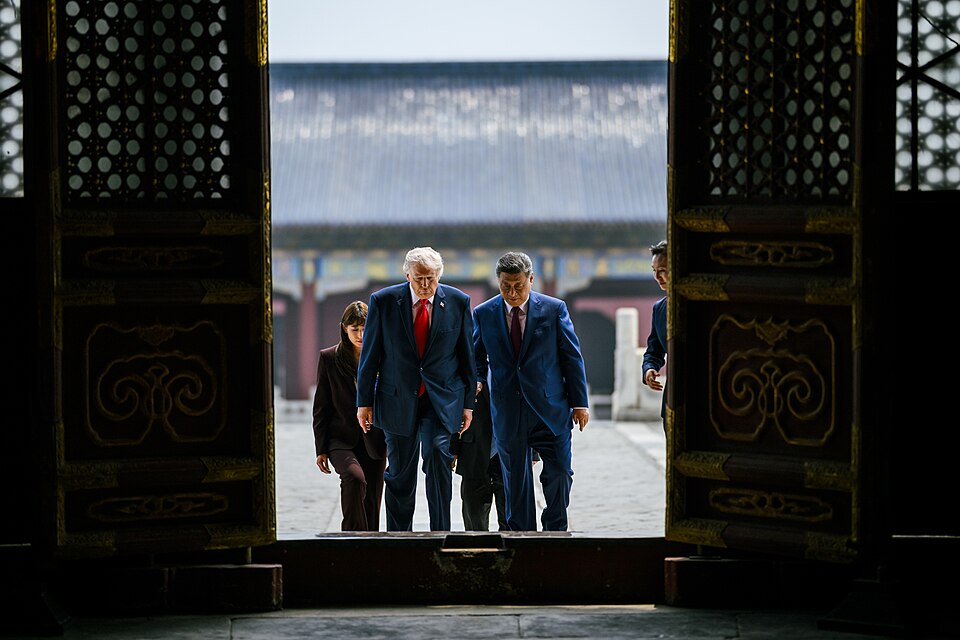
There is a structural resemblance between Nixon’s visit and Trump’s. Both came at moments when the U.S. was under strategic pressure, when American society was fatigued, and when the costs of global responsibility were rising.[6] In both episodes, China treated sovereignty as a red line and responded to maximum pressure with long-term strategic patience. Both sides lacked trust, but they understood that full confrontation would carry intolerable costs.
Of course, the world of 2026 is no longer the world of 1972. Nixon faced the stalemate in Vietnam, the deterrent reality of Soviet nuclear power, and the damage to American hegemonic credibility after the collapse of the Bretton Woods system. A key foundation of U.S.-Chinese rapprochement was that both sides felt the Soviet threat. In that sense, one of the most important meetings of the 1972 negotiations may have been the February 23 discussion between Kissinger and Vice Chairman Ye Jianying. Kissinger briefed Ye on the Soviet military deployment in the Far East, down to the position of each division, its personnel, the details of its equipment, and the progress of U.S.-Soviet negotiations.[7] The intelligence showed that Soviet forces in the Far East in the 1970s were even larger than those stationed in Eastern Europe. Ye said that this important information made him feel the sincere desire of the U.S. government to improve relations with China.[8] On that basis, Nixon used realism to open the door to Beijing and reorganize the structure of the Cold War.
Trump today faces different pressures: the wars in Iran and Ukraine, the risk of U.S.-Chinese economic decoupling, technological competition, and growing frustration among U.S. allies. China and the U.S. now see each other as their principal competitor, while Russia’s power and prestige have been continually drained by a war even more protracted than the Great Patriotic War. The buffering function of the old strategic triangle has weakened. U.S.-Chinese tensions are now concentrated in the bilateral relationship itself. The point of returning to 1972 is not to copy history, it is to recover a method.
The first lesson of the spirit of 1972 is that strategic judgment must be restored before specific issues take control of the agenda. The philosophical conversation between Mao and Nixon was, at its core, an effort to answer how China and the U.S. understood the world, each other, and the main threat. Today’s leaders need to answer similar questions. Do the two countries accept that the other will remain a major power for a long time to come? Can the U.S. accept that China will have greater regional influence and a larger voice in global institutions? Can China accept that the U.S. will continue to play a leading role in the Indo-Pacific and in the global order? The most dangerous condition in great-power relations is not competition itself; it is competition stripped of political, military, and linguistic restraint. If both sides recognize that global power shift is irreversible and that competition requires rules, the relationship can move from crisis management toward strategic stability.
Xi Jinping and Donald Trump have agreed to define the relationship as “constructive strategic stability” between China and the United States. Foreign Minister Wang Yi has described this as a stable relationship marked by cooperation as the main direction, competition kept within limits, differences kept under control, and peace kept within reach.[9] Such a formulation does not deny competition, nor does it promise comprehensive cooperation. It seeks to set boundaries around competition, install guardrails around disagreement, and give the contest between the two powers some degree of predictability.
Taiwan was, and remains, the central issue in U.S.-China relations. Few places in the world carry so many meanings at once: sovereignty, identity, deterrence, and great-power credibility. The island also sits at the throat of the AI supply chain. The experience of 1972 suggests three ways to prevent the Taiwan question from spinning out of control. First, public commitments must be cautious; they should not create a victory narrative for one side and a defeat narrative for the other. Second, military actions must be restrained, especially in close air and maritime encounters where an accident could create a chain of escalation. Third, both sides need to reinterpret the connection between opposing Taiwan independence and preserving peace and stability. The U.S. must avoid allowing Taiwan to exhaust China’s patience. China must avoid allowing military pressure to swallow the space for a peaceful solution. If Washington truly wants stability, it should not play linguistic games with the one-China principle or tolerate efforts by Taiwan’s authorities to alter the status quo incrementally. If Beijing wants a more favorable long-term environment, it must preserve the credibility of peaceful reunification and allow Taiwan’s society to see guarantees that its way of life will not be changed. Power politics does not exclude patience. True great-power patience comes from strength, discipline, and a sense of time. Secretary of State Marco Rubio said in an NBC interview that “China’s preference is probably to have Taiwan willingly voluntarily join them. In a perfect world, what they would want is some vote or a referendum in Taiwan that agrees to fold in.”[10] Such a statement suggests that the window for stability still exists. But it requires careful political maintenance.
Trump-style diplomacy values visible transactions: airplanes, agricultural products, energy, investment, and market access. These outcomes have domestic political value and can improve the atmosphere. Information released by the Chinese side indicates that the two economic and trade teams have reached “overall balanced and positive results,” including continued implementation of previous consultation outcomes, the creation of trade and investment councils, handling market access for agricultural products, and expanding two-way trade under a reciprocal tariff-reduction framework.[11] If such arrangements can be institutionalized, short-term deals may be turned into long-term mechanisms.
Genuine economic stability requires three types of arrangements: transparency about supply-chain risks, predictability in export controls and critical-mineral restrictions, and institutionalized boundaries around technological competition. This does not mean that China and the U.S. can return to old-style globalization. The U.S. will not abandon reindustrialization or technological security. China will not abandon industrial upgrading or supply-chain autonomy. A realistic goal is limited interdependence, not comprehensive decoupling. The two sides can compete in sensitive technologies while maintaining market openness in less sensitive areas. They can establish crisis notification mechanisms for critical minerals and semiconductors while expanding mutually beneficial trade in agriculture, energy, services, and consumer goods. They can recognize the reality of industrial-policy competition while preventing subsidies, sanctions, and export controls from expanding without limit.
AI, in particular, must be included in the framework of strategic stability. In his later years, Kissinger repeatedly warned that the strategic reality created by AI resembled the early nuclear age: all sides knew it would change the structure of power, but no mature rules yet existed to manage the risks. Algorithms, computing power, and data have become instruments of unchecked nationalist mobilization. If AI is further militarized, the speed of U.S.-Chinese misperception will far exceed the reaction time of traditional diplomacy.
Since 1972, U.S.-China relations have always had a significance that exceeds the bilateral frame. Normalization in the 1970s split the Soviet-led socialist camp and, in effect, ended the Cold War. Today, China and the U.S. sit at the center of a global power shift. The U.S. still possesses advantages in finance, military power, technology, and alliances, but it is increasingly unable, and increasingly unwilling, to bear the full cost of maintaining global order. China has manufacturing capacity, a vast market, infrastructure networks, and expanding diplomatic influence, but it has not yet fully assumed the role of a provider of global public goods. Still, great powers remain great powers. As nuclear and trading powers, China and the U.S. continue to share interests on many international issues. The crisis in the Strait of Hormuz is one example. Neither country can accept Iran’s acquisition of nuclear weapons, nor can either accept a prolonged closure of the Hormuz shipping lane.
The diplomacy of 1972 succeeded because both sides shared a recognition of danger, a sober understanding of power, and the political capacity to handle differences. U.S.-China relations in 2026 need no romantic expectations. The two countries will continue to compete over technology, industry, regional influence, political narratives, and global rules. The real question is what form that competition will take. It can be kept in a manageable state through rules, mechanisms, and limited concessions. Or it can gradually spiral out of control under the mutual pressure of sanctions, military deterrence, and nationalist mobilization.
Conclusion
“Ten thousand years is too long; seize the day” is not a call for China and the United States to rush into a great deal. Nor does it ask either side to abandon principle in exchange for a temporary atmosphere of calm. Improvement in U.S.-China relations will not grow naturally from goodwill. It can arise only from interest-based exchange, a clear logic of power, and the fear of mutually assured destruction. The legacy of 1972 is the ability to manage hostility amid hostility, limit competition amid competition, and create order amid disorder. The stability and peace of the world still depend on whether China and the U.S. can grasp this lesson at the hardest moment and translate it into sustainable strategic action.
[1] Richard Nixon, ‘Toasts of the President and Premier Chou En-lai of the People’s Republic of China at a Banquet Honoring the President in Peking’, The American Presidency Project, 21 February 1972 https://www.presidency.ucsb.edu/documents/toasts-the-president-and-premier-chou-en-lai-the-peoples-republic-china-banquet-honoring [accessed 13 May 2026].
[2] “Memorandum of Conversation”, Beijing, 21 February 1972, in Foreign Relations of the United States, 1969–1976, XVII: China, 1969–1972, ed. by Steven E. Phillips and Edward C. Keefer (Washington, DC: Government Printing Office, 2006), doc. 194.
[3] “Memorandum of Conversation”, Beijing, 23 February 1972, in FRUS, 1969–1976, E–13: Documents on China, 1969–1972, ed. by Steven E. Phillips (Washington, DC: Department of State, 2006), doc. 92.
[4] “Memorandum of Conversation”, Beijing, 26 February 1972, in FRUS, XVII, doc. 201; “Memorandum of Conversation”, Beijing, 25–26 February 1972, in FRUS, E–13, doc. 102
[5] “Memorandum of Conversation”, Beijing, 24 February 1972, in FRUS, XVII, doc. 199; ‘Joint Statement Following Discussions With Leaders of the People’s Republic of China’, in FRUS, XVII, doc. 203.
[6] Margaret MacMillan, Nixon and Mao: The Week That Changed the World (New York: Random House, 2007), pp. 1–12; Henry Kissinger, On China (London: Allen Lane, 2011), pp. 219–76.
[7] “Memorandum of Conversation”, Shanghai, 27–28 February 1972, in FRUS, XVII, doc. 202.
[8] Ibid.
[9] Ministry of Foreign Affairs of the People’s Republic of China, ‘Wang Yi Briefs the Media on the China-U.S. Presidential Meeting and Common Understandings’, 15 May 2026, https://www.mfa.gov.cn/wjbzhd/202605/t20260515_11911513.shtml [accessed 16 May 2026].
[10] U.S. Department of State, ‘Secretary of State Marco Rubio with Tom Llamas of NBC News’, 14 May 2026, https://www.state.gov/releases/office-of-the-spokesperson/2026/05/secretary-of-state-marco-rubio-with-tom-llamas-of-nbc-news [accessed 16 May 2026]
[11] Ministry of Commerce of the People’s Republic of China, ‘MOFCOM Spokesperson Answers Questions on the Preliminary Outcomes of China-U.S. Economic and Trade Consultations’, 16 May 2026, https://www.mofcom.gov.cn/syxwfb/art/2026/art_0e8dac7e772e4339bf622ddc7717e5e1.html [accessed 17 May 2026].