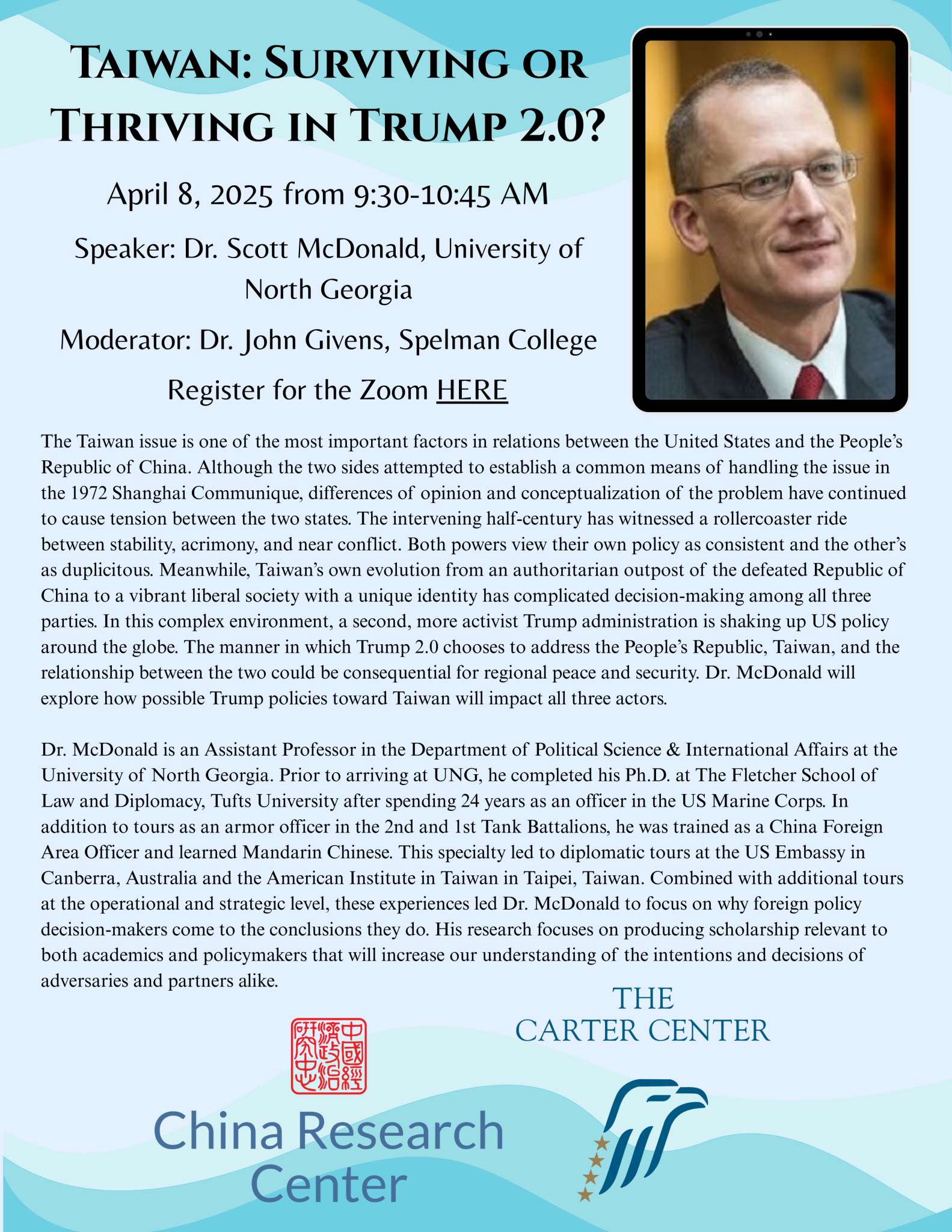

Speaker: Dr. Scott McDonald, University of North Georgia
Moderator: Dr. John Givens, Spelman College
The Taiwan issue is one of the most important factors in relations between the United States and the People’s Republic of China. Although the two sides attempted to establish a common means of handling the issue in the 1972 Shanghai Communique, differences of opinion and conceptualization of the problem have continued to cause tension between the two states. The intervening half-century has witnessed a rollercoaster ride between stability, acrimony, and near conflict. Both powers view their own policy as consistent and the other’s as duplicitous. Meanwhile, Taiwan’s own evolution from an authoritarian outpost of the defeated Republic of China to a vibrant liberal society with a unique identity has complicated decision-making among all three parties. In this complex environment, a second, more activist Trump administration is shaking up US policy around the globe. The manner in which Trump 2.0 chooses to address the People’s Republic, Taiwan, and the relationship between the two could be consequential for regional peace and security. Dr. McDonald will explore how possible Trump policies toward Taiwan will impact all three actors.
Dr. McDonald is an Assistant Professor in the Department of Political Science & International Affairs at the University of North Georgia. Prior to arriving at UNG, he completed his Ph.D. at The Fletcher School of Law and Diplomacy, Tufts University after spending 24 years as an officer in the US Marine Corps. In addition to tours as an armor officer in the 2nd and 1st Tank Battalions, he was trained as a China Foreign Area Officer and learned Mandarin Chinese. This specialty led to diplomatic tours at the US Embassy in Canberra, Australia and the American Institute in Taiwan in Taipei, Taiwan. Combined with additional tours at the operational and strategic level, these experiences led Dr. McDonald to focus on why foreign policy decision-makers come to the conclusions they do. His research focuses on producing scholarship relevant to both academics and policymakers that will increase our understanding of the intentions and decisions of adversaries and partners alike.